 The magical hilltop town of Olvera
Olvera
There has been a human settlement on the site of Olvera for more than two thousand years. Archaeological findings suggest this verdant agricultural region north-east of Ronda was an important area for settlement as far back as the Palaeolithic era, at least twelve thousand years ago.
It was definitely settled as a town by the Phoenician and Roman periods, the latter calling it either Hippa or Hippo Nova. Its first appearance in history is in the 1st century ACE History of Pliny.
Like much of the Iberian peninsula, the area was overrun by Visigoths from the Baltic region in the 5th century ACE, and they were themselves expelled by Berber armies from north Africa in the 9th century. The Berbers, roughly termed as 'Moors' in most histories of Spain, began construction of the town, which they called Wubira, or possibly Uriwila, as a defensive garrison that they managed to hold on to under the rule of Granada's Nasrid rulers until the town fell to the Christian reconquistadores in 1327.

Studios and gallery in the beautiful Andalucian countryside producing hand thrown pottery and fused glass.
The origin of the town's name is unknown. As was often the case, Roman, Visigoth and Moorish names fused into the later Spanish word, and Olvera has been variously described as a neologism for a well, woodland or olive grove. Olive oil is one of the area's main agricultural products.
When Olvera fell to the conquering army of Alfonso XI in 1327, it came under the control of the Gúzman family, who were awarded control of much of the region for their role in the defence of Tarifa during the Reconquest. It later passed into the hands of the dukes of Osuna. Its most famous son is probably Nicolás de Ribera, born here in 1487, and one of the leaders of Spain's conquest of Peru. He was made mayor of its capital, Lima, in 1535.
Like the rest of Spain, Olvera suffered economically during the French occupation of the early 19th century, but flourished, briefly, in the shortlived republican revolution of 1868. It became notorious, like many a pueblo blanco, as a bandit refuge, so far from the arm of the law that it was immortalised in a famous Andaluz saying: 'Kill your man and flee to Olvera!'
Spain went into decline again at the end of the 19th century after the loss of its Cuban interests, but in the early 20th century Olvera hit a stroke of remarkable good luck. In fact, one of Olvera's key modern-day tourism attractions, the 38km ruta verde abandoned rail-line hiker/biker route linking it to Puerto Serrano, is the result of a small but crucial economic fillip in a period of economic downturn. The shortlived dictatorship of General Rivera between 1923-29 decided, in the late 1920s, that Olvera should be the key station on a new rail link between Almargen and prosperous Jerez de la Frontera. Between 1927 and 1930, Olvera flourished on its own tiny rail boom. The line was never completed, but today its levelled trackbed a via verde is one of the most remarkable walking experiences in Andalucía, with half a dozen viaducts, more than twenty tunnels, two wayside restaurants and a small hotel at the Olvera terminus.
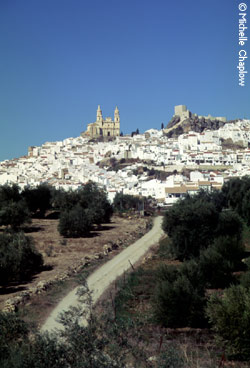
The años de hambre, 'years of hunger', after the Civil War affected Olvera like every other Spanish pueblo, inspiring an inevitable population drift towards the coast. Olvera continues to support its agricultural specialities, and its famed olive oils. Its remarkable castle, probably the finest surviving example in the region, has recently been renovated, and the dramatic Iglesia de la Encarnación church in fact hides one of Andalucía's best small museums behind its imposing bulk. The town was declared a centre of artistic and historic importance in 1983.
The Hermitage Church of “Nuestra Señora de los Remedios” (Our lady of the Remedies) is situated two kilometres from Olvera on the road to Torre Alháquime and Setenil. This is a unique building and well worth the visit. More >
The tourist office is in the Edificio la Cilla, Plaza de la Iglesia, by the Encarnación church, tel 956 12 08 16.
Olvera- Hotels
Book hotels in Olvera


