 The Carba town hall, complete with an engraving of a goat. © Michelle Chaplow
CABRA
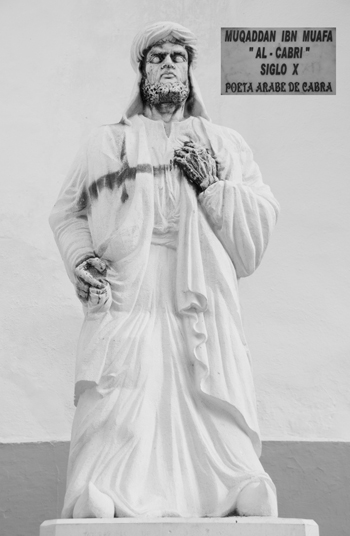
Cabra is the modern Spanish word for 'goat', but it is unlikely that local flocks inspired this town's name. It is thought to come from "Al-Cabri", a local poet from the tenth century whose full name was Muqaddan Irn Muafaa. The town now has around 20,400 inhabitants.
HISTORY
Evidence suggests that the settlement of Cabra dates to the Paleolithic era. During the Roman occupation, the original nucleus of the town was formed, built on the Iberian settlement known as El Cerro. With the fall of the Roman Empire, Cabra became an important capital of the Visigoth Kingdom, now known as Egabro, which was its own county and diocese between the sixth and eighth centuries. During the Guadalete Battle, King Rodrigo lost his kingdom. After a quick conquest based on treaties, Arab reign over the peninsula was imposed. It was at this time that the town's name changed to 'Qabra', evolving towards its present form. It was the capital of an extensive territory that covered much of the present-day bordering towns of the area. More>
THINGS TO SEE
Cabra has numerous historical highlights including the castle and parish churches, the house where famous singer Cayetano Muriel was born and the Archaeological Museum, Natural History Museum and Olive Oil Museum. More>
Hotels in Cabra
Book Hotels in Cabra


COUNTRYSIDE WALKS
Cabra is part of the Sierras de Subbéticas Natural Park which makes this area ideal for "active tourism" and adventure tourism. In fact, the nearby Sierra de Cabra is the highest point in the mountain range and is an official viewpoint. It is known by many as "Andalucia's Balcony". More>
The Via Verde de la Subbética railway path also passes Cabra along the old railway line between Puente Genil and Jaen.

natural areas
Parque Alcántara Romero
The Alcántara Romero Park was built in 1848, when José Alcántara Romero was mayor of the city. This large park is a beautiful example of nineteenth-century gardening. Its high level of biodiversity, the extreme uniqueness of many of its plant specimens, its architectural characteristics and the age of the park make it one of the most outstanding green areas of the province.
GASTRONOMY
Every town and village in Andalusia offers local specialties worth sampling, and Cabra is no different. If you're only visiting briefly or passing through the town, stop for a coffee and a pastry on the Plaza de España, which offers an excellent selection of local pastries known as pasteles. The bizcotelas, made by the Madres Agustinas, are thought to be the best. Some of the local main dishes include ensalada con queso de cabra (goat cheese salad), flamenquin (pork roll stuffed with cheese and ham), sopa de maimones (ham and egg soup), lomo de orza (roast pork), remojón de bacalao y naranja (cod and orange), mojete de patatas (potato stew), rabo de toro (oxtail) and porronchos (fritters).
festivals
Cabra is famous for the National Gypsy Pilgrimage, which traditionally takes place on the third Sunday of June. Click for more on the Cabra Gypsy Festival, or more on other festivals at Cabra.
NEARBY PLACES
The neighbouring villages to Cabra are Doña Mencía, Monturque, Lucena and Priego de Córdoba.