History
The history of Dehesa de Guadix originates during the Granada War, when the Catholic Monarchs granted land to Don Diego Fernández de Iránzo in 1491, a donation later confirmed by King Felipe V in 1751.
The history of Dehesa de Guadix originates during the Granada War, when the Catholic Monarchs granted land to Don Diego Fernández de Iránzo in 1491, a donation later confirmed by King Felipe V in 1751.
The tourist office of Beas de Guadix
If you are considering visiting this town you will be interested to check the latest weather forecast for the next few days from the table below.
List of Festivals
There is a bus service from Beas de Guadix to Granada City using the local bus company,BAM.
The archaeological complex consists of the Mozarabic Necropolis, three tenth-century silos, a prehistoric dolmen known as 'Pileta de la Zorra', a defensive system from the Spanish Civil War (1936) and one of the few remaining Mozarabic farmhouse settlements in Andalusia, dating from the ninth to twelfth centuries.
Puerto Lope had its own jurisdiction and Town Hall in 1824, but these were completely burned down during the Peninsular War The town and its church were lost, but were restored in 1840. The church featured an elegant high altar and a wooden pulpit accessed by a matching staircase, as well as a large marble baptismal font. The church was donated to the town by its owner, Don Eduardo Estrala.
The Moclín Interpretation Centre houses important local archaeological artefacts. It is located on Calle Saturia Pardo.
At the beginning of the Christian town stands the Casa del Pósito, a 16th-century public granary attributed to Pablo de Rojas. Located on Calle Mota.
This is the former parish church of Santa María de la Encarnación, which was founded by the Catholic Monarchs. After being damaged during the Spanish Civil War (1936–1939), it was restored in the twentieth century and used as a church, service chapel and sacristy. The main chapel, designed by Martín Bolívar, was built in the mid-sixteenth century, and the rest of the nave was added later.
During the Nasrid reign, Moclín Castle was formerly known as 'Hisn Al-Muqlin' (Fortress of the Two Pupils), alluding to its clear role as a permanent sentinel. Dating from the Nasrid period, the castle was built in the mid-fourteenth century using elements from an earlier period. It was constructed as a border castle between the Kingdoms of Granada and Castile.
Prehistoric sites such as the 'Andalusian Neolithic Sanctuary' (Cueva de Malamuerzo) and numerous cave paintings can be found scattered throughout the mountain ranges (Corcuela, Cueva de las Vereas, Bermejas, Araña, etc.). With the rise of Latin culture came the Roman villas of Tiena La Alta and Olivares, as well as the silos of Tózar.
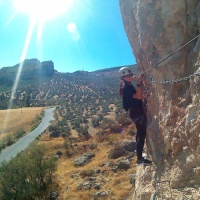
Harness? Check. Helmet? Check. The only thing you need to bring with you on this guided climbing expedition from Granada is a pair of comfortable shoes and a few vials of courage!