Fuente de San Antonio
The fountain is located next to the Iglesia de Santa Cruz and is sheltered by a niche.
This is one of the most popular fountains in Pampaneira as it has a constant flow of water.
The church stands out from the rest of the town thanks to the ochre colour of its tiles and the brickwork of its walls. It dates back to 1501, when the parish was attached to that of Capileira de Poqueira. On 15 October that year, Diego Hurtado de Mendoza, Archbishop of Seville, canonically established the original parish of Pampaneira alongside 44 others in the Alpujarra Tahas.
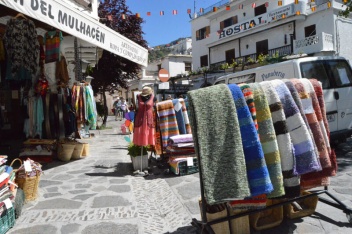
Pampaneira's history is similar to that of other towns in Granada's Alpujarra region. Due to its geographical isolation, the area developed its own distinctive characteristics, reaching its moment of greatest splendour during the Arab-Andalusian period when it was an important agricultural centre specialising in silk production.
One of a trio of popular and picturesque whitewashed villages, Pampaneira – like its neighbours Bubión and Capileira – hugs the steep slopes of a lush river gorge, the Barranco de Poqueira. Pampaneira is the lowest of the three, at just over 1,000m. The small village – with a population of around 300 – centres on its pretty square dominated by a 16th-century Mudéjar church
Popular festivals in Pampaneira are Feria Agrícola, del Turismo y la Artersanía, Semana Santa and Día de Santa Cruz.
The tourist office of Pampaneira is located in the Nevadensis.
Weather forcast for the next five days for Pampaneira.
There is a bus service from Pampaneira to Granada using the local bus company.