Caserío de Abrahantes, Casa de Doña Eva y Juzgados
This group of historic buildings in Pinos Puente includes the seventeenth-century Caserío de Abrahantes, the courthouse on Plaza Iglesia, and the Casa de Doña Eva on Calle Real.
This group of historic buildings in Pinos Puente includes the seventeenth-century Caserío de Abrahantes, the courthouse on Plaza Iglesia, and the Casa de Doña Eva on Calle Real.
Dating back to the early twentieth century, the Alambique was built by the Espadafor family and later became municipal property, now housing the Pinos Puente Youth Centre.
The church features a sober, classicist façade with a semicircular arch and simple decoration, and its interior consists of three naves separated by large octagonal pillars.
The Interpretive Centre explores the connection between Christopher Columbus and the discovery of America and the province of Granada.
The bridge, which is classified as a Caliphate bridge, has been designated a Site of Cultural Interest since 1922. While the exact date of its construction is unclear, the bridge has undergone various reconstructions and alterations over the centuries, suggesting that it may have been built during the Roman era (Fernández, 2013)
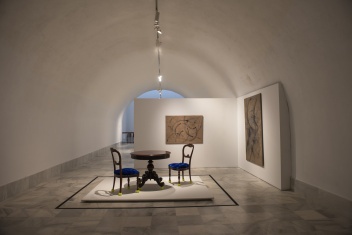
ECCO is a cultural space, showcasing various mediums of art, with occasional daytime and evening events.
Duration: 45 min. Length: 1470 m. Difficulty: Medium. The route and can be accessed by the “Cordel del Gollizno” cattle route that starts from the vicinity of the Ermita de Cánava.
The Pinar de Cánava is a forest that forms part of the Sierra Mágina Natural Park. Of its 120 specimens of pine, the Aleppo pine dominates. The forest is renowned for the longevity of its trees, with many between 100 and 250 years old. As well as being of great scientific and educational value (demonstrating the pine lifecycle), the forest is an important habitat for species such as the wood pigeon and Bonelli’s eagle. The forest also offers visitors beautiful panoramic views of the Sierra Mágina, the Campiña de Jaén olive grove and various towns including Jimena, Torres and Albanchez de Mágina. Declared an Andalusian Natural Monument.
The chapel of Nuestra Señora de los Remedios sits on the road to Albanchez, at the foot of the mountains. Nestled between palm trees and a fountain, it is a small temple with a cross-shaped floor plan, built in 1910. Located southeast of the town, on the J-3105.
These important cave paintings were discovered in 1902, and comprise seven groups of figures painted in red hues. They are attributed to the Neolithic period, around the third millennium BC. The figures are human representations in the “brazos en asa” style, along with abstract animal figures such as bulls, goats and horses, as well as symbols which are difficult to interpret. A scene of grazing animals highlights the functional importance of animals to the prehistoric community, whilst other animal figures suggest a link between fauna and the divine. Declared a National Historic Monument in 1924 and now an Asset of Cultural Interest. Located on Calle Audiencia.
The imposing Torre del Homenaje is part of the Castillo de Jimena, which was built by the Arabs as a defensive fortress in the tenth century. After it was conquered by Fernando III in 1234, the castle became part of the city of Baeza and later passed into the hands of the Nasrids. In 1457, the castle was handed over to the Order of Calatrava, who reformed its defenses and adapted it into a manor house, eventually becoming the property of the Marquises of Camarasa. The tower itself was Declared an Asset of Cultural Interest in 1985: the painted frescoes inside have largely deteriorated, and only parts of a naval scene are still visible today. Located in Plaza de la Constitución.
This church is named after the day of festivities which took place when Fernando III won Jimena from the Arabs in 1234. The church was built in the Gothic style, with features like pointed arches, offset by a Renaissance, semicircular entranceway. The church has undergone various restorations, and the current roof, three golden altarpieces, carving of the Virgen del Rosario and square tower all date from 1960. Located on Calle Audiencia.
The gorge sits on the border of Campillo, Cárcheles and Cambil. Caused by fluvial erosion, the limestone wall is approximately 400m high. Between the 1970s and 80s, the construction of the Bailen-Motril highway transformed the area of Puerta de Arenas, opening a new tunnel in the rock as well as a bridge over the river. This modified the landscape and offered improved communication routes. Visitors can also find a recreational area which allows for bird watching and hiking and features a botanical garden and picnic area.
This chapel was built using alms collected from devotees who passed through Puerta de Arenas and stopped to pray before the saint. This worship was initially carried out towards a painting of the saint placed against the rock walls, until a proper image was established in a small niche in 1840. Once enough donations had been collected, the first chapel was built in 1858. The blessing was attended by the local authorities and more than 2,000 devotees from all over the region. The chapel deteriorated over time and required numerous restorations. At the end of the 1990s, the Puerta de Arenas recreational area was built, offering bird watching, a botanical garden, hiking and a picnic spot. Located north of the town, off the N-323A.
Situated 1393m above sea level, the castle sits on the Cerro del Castillo de Puerta Arenas, in the Sierra de Alta Coloma, between Granada and Jaén. The Portillo del Río Campillo is the only practicable pass to cross this Sierra. The castle stands on an L-shaped ridge, whose ends are two promontories defended by cuts in the terrain. Today, the castle is in a ruinous state. Located north of the town, off the JV-2228.
Construction of the church began in 1579. The project was carried out by Don Manuel Sancho Sánchez, a master stonemason, and Don Benito el Santo. In 1618, the main altarpiece was built, but it was later destroyed in the Spanish Civil War. Its style was somewhere between Renaissance and Baroque, decorated with elements typical of the period. The presbytery was completed on its side walls, with two large oil paintings. The organ was placed in the choir in the middle of the eighteenth century and the bells were installed in 1858. In 1906, a clock with Roman numerals was installed on the façade of the tower facing the main square, paid for by the council. In the 1980s, this machinery was removed and replaced with an electronic device; in 1996, the original clock was restored and donated to the Town Hall, where it is currently on display in the Salón de Plenos. The church and Town Hall are both located in Plaza de Andalucía.
The chapel dates from the middle of the eighteenth century, according to the Cadastre of the Marqués de la Ensenada. The numerous religious offerings that are preserved in the sacristy of the hermitage, as well as the embossed silver lamp dedicated to the Virgin, from the year 1741, are proof of the local fervour for the Virgin. In 1956 and 1975, the dressing room was redesigned. In 1991, the chapel was restored and the dressing room underwent a third restoration. Located on Calle Carril de la Ermita.
This castle was built as a surveillance point over the secondary pass between ndalusia and La Mancha, commonly known as the Camino de Castellar de la Mata (today Castellar de Santiago). Its construction is attributed to the Almohads, although other evidence highlights that it was used to reinforce the borders after the Battle of Las Navas de Tolosa (1212). It was in operation until the fall of Santisteban in 1235, most likely abandoned due to the sale of Santisteban to Fernando III. Today, it sits in a ruinous state, with one of its most visible walls pierced with an enormous hole. Declared an Asset of Cultural Interest.
This chapel has undergone several reconstructions over the years; it was originally built in the fourteenth century on the remains of the collapsed Castillo de la Estrella. Some parts of the original fortification have been preserved, such as the two blinded Muslim arches that formed the frontispiece, and the homage tower (now repurposed as a bell tower). The new chapel was built in 1892, and its construction was commemorated by placing some coins and an inscribed lead plate in a cavity in the façade. Located 5km from the town off the JA-7103.
This small chapel, commonly known as Capilla de ArribaCapilla de Arriba, is a single-storey structure composed of a semicircular portico, which previously sat in the old cemetery and was relocated to this construction in 1988. However, it is believed that it once belonged to the now disappeared Ermita de San Sebastián. Located on Calle del Sol.