Attractions

Sierras de Cazorla, Segura y Las Villas Natural Park

With a total surface area of 209,920 hectares and covering almost a fifth of Jaén province, this is Spain’s largest protected area and one of its most extensive forested zones. Located in eastern Jaén province, it connects the Sierra Morena and the Subbética mountain ranges. The highest peak in this immense park is Pico Empanada at 2,107m and the entire park is higher than 600m. Recognizing its exceptional ecological importance, it was designated a UNESCO Biosphere Reserve in 1983 and created a natural park in 1989. Barren rocky crests and vast pine forests will strike visitors’ first impressions, but the area’s botanical importance within Andalusia is matched only by the Sierra Nevada, with a fifth of the vascular plants in the Iberian Peninsula found in the Sierra de Cazorla Natural Park.

Hoya los Trevejiles

This forest house is the ideal starting point for walking routes through the Natural Park and discovering the Sierra de Las Villas in depth.

Ermita de Santa Quiteria

The chapel dates to 1511 and is cited among the hermitages belonging to the Archpriesthood of Iznatoraf. It has a single nave and lacks architectural value, due to the numerous reforms that it has undergone. Located 3km from the town centre, in a place popularly known as “Cerrico Pelón”, off the J-6220.

Plaza de los Caños

The fountain has seven spouts, with various water pressures. The four spouts on the left lead from the Moscoso orchard, from where it is channelled under the even-numbered houses of Calle Prado, and the three pipes on the right are supplied from the upper part of Calle Mina. Its central location makes this square a point of reference and orientation for locals. The successive remodelling of the square eliminated another fountain that once served as a watering hole for animals. Even so, it retains elements worth mentioning, such as the large mansions that surround the square and the traditional public laundry area. There is almost no season of the year in which the square does not become the scene of celebrations and events.

Iglesia Parroquial de Santa Águeda

The Renaissance church was built on the site of a former temple by Alonso de Barba, a favourite disciple of Andrés de Vandelvira. The chancel was carved by the master stonemason Sebastián de Solis, and the work was completed in 1582. The design consists of a single nave, covered with a pair and knuckle wood frame, according to Mudejar tradition. The most outstanding feature is the main chapel, with a rectangular base, which is accessed by a staircase and grand pair of semicircular arches with large carved allegorical figures of Fe and Caridad, and voussoirs and geometric decoration characteristic of Alonso Barb. The coat of arms of Bishop Francisco Delgado presides over the central headwall. Outside, the nave is covered with a wide gabled roof and the entrance to the church is through a simple doorway on a staircase with a semicircular arch lined with imposts and a small frieze with an inscription dated 1582. The belltower is also noteworthy, designed by Andrés de Vandelvira. The carving of Santa Águeda dates from the sixteenth century. Located on Calle Reyes Católicos.

Torreón Árabe (Torre del Homenaje)

The tower was built in 886 by order of General Hashim ben Abd al-Aziz. Archives reference the existence of an old Arab castle in the town, built in the middle of the ninth century to fortify the left bank of the Guadalquivir River and to serve as an outpost for the Iznatoraf fortress in its defense of the pass over the river, but the vestiges that have survived to this day show a clear Christian construction, of which only one tower has been preserved. According to Manuel de Góngora, who studied the archeology of the province of Jaén, it was built on a the site of a Roman fortress. Located on Calle Eras.

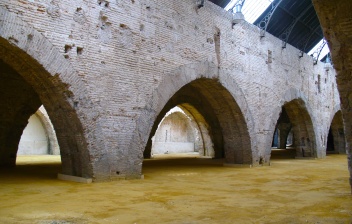
Atarazanas de Sevilla

The Atarazanas are Seville’s medieval Royal Shipyards in the Arenal district, formerly the port area. They are located about halfway between the Alcazar palace and the river, on the corner of calle Temprano and calle Dos de Mayo. The shipyards are currently closed to the public (January 2025), although long-standing plans for a cultural centre are predicted to be finished soon.

Iglesia de Santo Domingo Guzmán - Torres

The church of Santo Domingo de Guzmán was built between the 16th and 17th centuries in the Renaissance style.  On closer inspection, there are features that show that it also departed from pure classicism to merge with popular forms of construction. 

Iglesia del Santo, Torres

The Iglesia del Santo, also known as the Ermita de Santo, is a small church in the centre of Torres, built in stone and plastered and painted white in the traditional way, with decorative corners that reveal the stonework.

Palacio del Marqués de Contadero

The palace was built in 1788, although it does have features from sixteenth century Renaissance. The grounds house the tourism office of the Regional Government of Andalusia in Úbeda. Located in Calle Baja del Marqués.

Palacio Vela de los Cobos

The palace was designed in 1551 by architect, Andrés de Vandelvira. To this day it remains the habitual residence of the family that has owned it since it was purchased by their ancestor, Ignacio de Sabater y Arauco, in 1873 who undertook a sumptuous refurbishment of the interior. /p>

Palacio Marqués de Mancera

An example of a turreted palace house of medieval heritage, an anachronistic symbol of old warrior lineages, dating to the sixteenth and seventeenth centuries. Residence of Pedro de Toledo y Leiva, First Marquis of Mancera, Captain and fifteenth Viceroy of Peru. /p>

Casa de las Torres

The house is a remarkable building that owes its name to the strong towers of its main façade, a great sample of Plateresque composition from the year 1520. Originally a medieval palace, built by Constable Ruy López Dávalos, it has undergone various changes in its construction over the centuries. /p>

Palacio de Juan Vázquez de Molina

The construction of the palace of Juan Vázquez de Molina began around the year 1562. It was built according to the design of the prestigious architect, Andrés de Vandelvira, who six years later delivered the finished work to its promoter, Don Juan Vázquez de Molina. /p>

Palacio de los Condes de Guadiana

The Palace of the Counts of Guadiana was built in the last years of the sixteenth century, and is organized around a small central courtyard. On the outside, its façade is decorated with balconies crowned by Mannerist style split pediments.

Palacio del Deán Ortega

The palace was ordered to be built by Fernando Ortega Salido, Dean of the Catedral de Málaga and Cantor of the Real Colegiata Iglesia de Santa María de los Reales Alcázares and first Chaplain of the Sacra Capilla del Salvador.

Convento de Santa Clara

The Royal Convent of Santa Clara is the oldest conventual foundation in Úbeda, built in the thirteenth century, and is still inhabited by cloistered nuns. It was the first nunnery in Úbeda after the re-conquest and Queen Isabel la Católica stayed there in 1489.

Iglesia de San Pablo

The church is one of the oldest in Úbeda and is believed to have been built since the Visigoth period. Its location in a central square and its proximity to the old Town Hall make it have a marked assembly character, since until the fifteenth century, the City Council and the nobles met there.

Plaza de Toros

The bullring sits on the land that was formerly occupied by the orchard of the Convento de San Nicasio. Materials from another convent, San Antonio, located on the Camino Viejo towards Baeza, were used for its construction.