Town Hall and old Court House
In 1502 King Charles I was made aware of the need to build a new prison in Baeza due to the poor conditions of the existing one. The building was constructed in 1520 and the Casa de Corregidor was constructed in 1559.
In 1502 King Charles I was made aware of the need to build a new prison in Baeza due to the poor conditions of the existing one. The building was constructed in 1520 and the Casa de Corregidor was constructed in 1559.
The Casa del Populo was built around 1535 in a Renaissance architectural style in two sections. In the lower section there are six linteled openings, one for each Notary's Office. On the façade between each office there are ornamental columns ‘supporting’ a lateral lintel and above this, keystones decorated with engravings of seven lions. In between on the façade are six shields of the city.
The old butchers building was both a butchers and Municipal slaughterhouse. The original building was built in 1547 during the reign of Charles V and was located outside the city walls. In the 1960s it was rebuilt in the newly reformed Plaza del Pópulo. As the original building was longer than the new Plaza de Pópulo the ends were "folded" back to the sides.
This is a typical Andalucian tree-lined avenue with bars and restaurants, where the old folk sit on wrought-iron benches in the shade of the vast palms. You will find a number of good restaurants with outside terraces along the east side of the square - the restaurants are actually built into the old city wall and, unusually, have entrances on both sides of the wall.
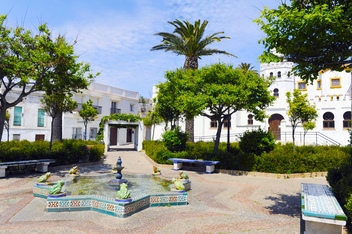
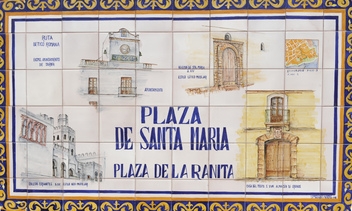
This central plazain Tarifa town has three names. Officially called Plaza de Santa Maria, after the church on one corner, its older name of Plaza Alfonso XII is still on the wall. However it is known locally as Plaza de la Ranita, or Little Frog Square, thanks to its unusual star-shaped fountain featuring eight ceramic frogs, one on each point, and a very Moroccan shade of turquoise.
The Municipal Museum in Tarifa is well worth a visit. It is located in the same attractive square as the Town Hall, officially called Plaza de Santa Maria, but known locally as the Square of the Little Frog. Inside you can see artefacts from Neolithic, Roman and Moorish times.
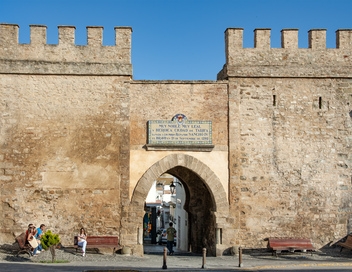
Jerez Gate is is a medieval gateway flanked by two crenellated towers and the only entrance through the old Moorish city walls that remains today of the four original ones - as the name suggests, this gate gave access to the road northwards to Jerez de la Frontera.
The Chapel of Nuestra Señora de la Visitacín dates back to the 18th Century and the present San Roque Hermitage was built in 1801.
No place is more emblematic of the ´´Christian´´ part of the city. Surrounded by 19th Century town houses, shaded by leafy lime trees - and in the midst of a large pedestrian zone - the Plaza Bibarrambla is the real heart of the city´s social life. Much of the square is in the warm months filled with sidewalk cafes, where you can enjoy hot chocolate and churros, and, on summer afternoons freshly made horchata de chufas, a refreshing milkshake made of a root called an ´´earth almond´´.