Vieja Fábrica de Harina - Fuerte del Rey
This interesting structure was once the flour factory. Built in 1930 and in operation until 1974, it is one of the oldest flour mills preserved in the province.
This interesting structure was once the flour factory. Built in 1930 and in operation until 1974, it is one of the oldest flour mills preserved in the province.
The Town Hall is a simple and functional building with a long and low structure.
The tower, also known as “El Torreón”, is located about 452 meters above sea level, in the watershed defined by the Cerrillo del Limón and El Torreón, with the limit of the municipal term of Fuerte del Rey 4400 meters to the south, and that of Cazalilla 7700 meters to the north.
The archaeological site of Las Atalayuelas is an Iberian oppidum, which hosted an Iberian cult space, later assimilated by the Roman religion.
The chapel dates from the eighteenth century. Its main façade has a bench running at the foot, and its interior is accessed through a semi circular arch of exposed brick topped by a small niche. The composition is crowned by a belfry with a hollow for a bell and adorned with an iron cross.
The park is a huge public space that runs partly parallel to Parque del Emigrante. It is very popular for its extensive facilities, shady trees, colourful fountain and benches, as well as spaces for outdoor activities and children’s games.
This castle can be found in the Auringi countryside, and existed when the Roman legions under Scipio seized Jaén and the Carthaginians were defeated in the Battle of Castulo.
Situated on a small hill,4m of the height of this quadrangular tower have been preserved. On the surface there are glazed ceramic elements, from the Medieval period, as well as some from the Roman era.
Conde de Argillo is the oil produced at Finca Arroyovil, in the foothills of the Sierra Mágina. From its springs come the waters used to irrigate its 8,000 centenary olive trees, which produce Extra Virgin olive oil of the Picual olive variety.
The main square is an important meeting place for the locals, equipped with shady trees and benches to rest and talk. Many of the town’s most important streets converge at this point, including its emblematic Calle Maestra.
This palatial seventeenth-century house is also known as Casa de Doña Paz, named after the woman who lived there under usufruct with her two daughters until her death.
The church is the most significant cultural asset of Mancha Real, and its design and construction is credited to numerous prestigious architects from the sixteenth to eighteenth centuries, such as Andrés de Vandelvir, Juan de Aranda, Eufrasio López de Rojas and Ventura Rodríguez.
This former convent, with foundations dating from 1586, is now a private home. Of the previous building, only a small part of the façade is preserved, a section of exterior wall that appears divided into three sections by pilasters.

Experience a sea of adventures at Selwo Marina in Benalmádena. Be amazed by iconic marine animals like penguins. Discover tropical forest inhabitants and watch exotic birds flying.
Through educational activities and talks, you'll learn about the threats these species face and how you can help conserve them.
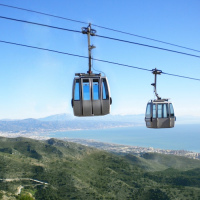
Enjoy views of the Málaga coastline from a bird's eye view in the only cable car on the Costa del Sol.
Following the Re-conquest, the mosques of Porcuna were destroyed and replaced with Christian temples. Surviving this erasure is the Torre de Boabdil (Museo Arqueológico de Obulco), considered by Juan Eslava as “the most beautiful example of military architecture in the Kingdom of Jaén”.
After the collapse of a previous Gothic Iglesia de Santa María la Mayor, the current church was erected on the same site, although incorporating the sacristy, which had been renovated in the seventeenth century by the mannerist Benito del Castillo.
The religious, administrative and social centre of Porcuna is the Plaza de Andalucía. The generously proportioned space features balconied houses and is accessed through a Gothic-style archway. The arch was once the gateway to the medieval fortress of the walled enclosure, and was rebuilt in 1952.
Located in Plaza de Andalucía.
The Neoclassical Town Hall was previously the Royal Pósito (grain store) and was built by Carlos IV in 1798. It has a basilica floor plan and is made of carved local ashlar. The façade presents, in the centre, a portal with a staircase and a door flanked by Tuscan pilasters on podiums. Inside are rooms 3A and 3B of the Archaeological Museum, housing an exhibition of the Prehistorical, Iberian and Roman culture of the city.
The chapel was once that of San Sebastián, with a Latin cross plan covered with a barrel vault. It also has a remarkable altarpiece with biscuit stipes and asymmetrical composition, and a profuse Baroque dressing room in rockery, from the eighteenth century.