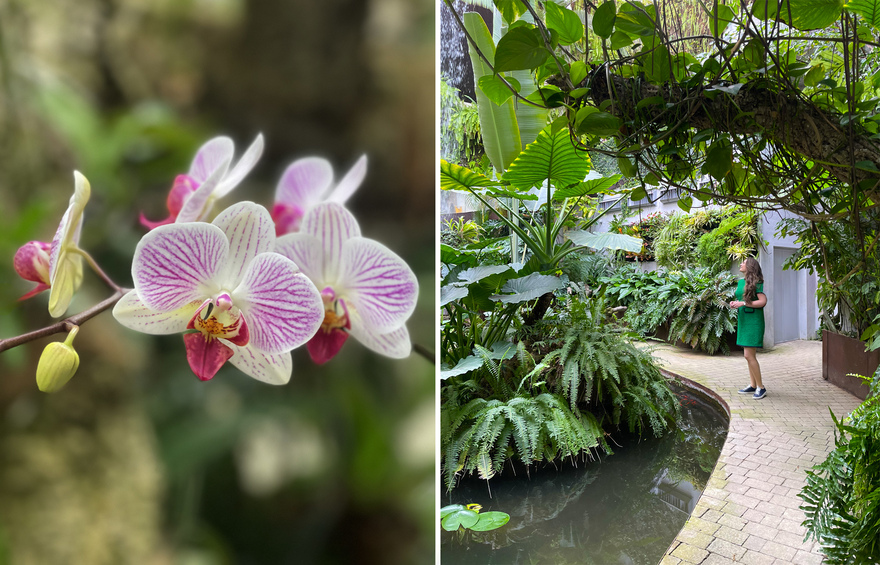
 The Estepona Orchid House
Estepona Orchidarium Tour
The Estepona Orchidarium Tour is a self-guided walk through the tropical greenhouse of the Orchidarium in Estepona. Along the winding internal pathway, visitors encounter green information panels placed at different stations. Each station describes different orchids and ecological aspects of the tropical environment.
Visitors can also follow an audio guide which uses the red numbered stations located throughout the Estepona Orchid House.
Station 1 -Cattleya Alliance
This parterre features Cattleya Alliance on both sides. This is a genus that includes nearly 40 different species of orchid, all of which originate from America. Examples include Cattleya, Laelia, Sophronitis, Encyclia and Epidendrum. Guarianthe, Caularthron, Broughtonia and Brassavola. All of these and many more can be found in the Estepona Orchidarium. They flower all year round, depending on the species.
They mostly love light and well-aerated roots, which need to be dry between waterings to avoid rot. They can tolerate relatively high summer temperatures (between 30 and 40°C) and varying degrees of light intensity, although it is advisable to provide some shade during the summer months.
Most of these orchids have cylindrical leaves (terete leaves) that resemble succulent plants. This is effectively a kind of adaptation to extreme conditions, using these leaves as reservoirs for water and nutrients. Others have developed hard, semi-rigid leaves with a pale colour to reflect sunlight more effectively.
The Cattleya's roots are thick and strong, covered with a dead cell layer that turns white when dry and green when wet. You can see how much the root bulb is stuck to the trunk of the tree, to the extent that it is impossible to remove the plant without damaging the roots.
The cattleyas are known as 'the queens of the orchids', and rightly so. Some species and hybrids have huge flowers, wider than the palm of a hand, with vibrant colours and exotic curls in the lower petal, known as the labellum, that resemble the curls of a Spanish gypsy dress..
Station 2 - Tropical Orchid Collection
This parterre comprises a wide variety of exotic species, all of which require the same high humidity levels. They originate from the entire tropical belt of our planet: South America, Madagascar & Central Africa, Southeast Asia, and Oceania (Australia, New Guinea, and nearby islands). Representatives of the genera Angraecum, Aerangis, Dendrobium, Gongora, Oncidium, Cattleya, Maxillaria and Bulbophyllum can be found here. These orchids are more demanding but are not unusual among orchid lovers. Several specimens of Sombralia fimbriata stand out, as they are terrestrial and their flowers are so beautiful — certainly extraordinary — and ephemeral. They are known as the 'one-day flower', although they only remain open for twelve hours.
In some of the branches, you can see several examples of Andgrecum sesquipedale, also known as the 'Christmas Star' because of the shape of its white, fragrant flowers, which are only perceptible at night. The flowers have a tube, or spur, that can reach up to 30 cm in length and produces nectar for a specific species of night sphinx.
Station 3 - Sun-Exposed Cattleya Alliance
This is another area for the Cattleya Alliance. This area is especially exposed to the sun and is home to 10 specimens of Myrmecophila tibicinis, an orchid that forms a symbiotic relationship with ants. There are also other species from South America and the Antilles, including Schomburgkia, Cattleva, Laelia, Encyclia, Brassavola and Epidendrum, all of which have pseudobulbs and thick, rigid leaves that act as reservoirs for nutrients and water. Other light-loving species come from Southeast Asia (Dendrobium, Vanda and Dockrillia), South America (Trichocentrum and Tolumnia), and Africa (Cymbidiella).
Station 4 - Rock-Growing Orchids (Lithophytes)
Not all orchids are epiphytes, i.e. plants that live on trees. Many of them are terrestrial species, like our Iberian ones, but they have rupicolous or lithophytic habits, meaning they live on rocks. In this rockery, you can see a collection of Hoffmanseggella (Laelia) orchids, which are native to Minas Gerais in Brazil, where they are exposed to extreme climate conditions with summer temperatures higher than 40°C. These unusual orchids have very thick, leathery leaves and are all small in size, which is a common adaptation to avoid water loss due to the heat. In their natural habitat, they feed on detritus and water stored within the rock crevices.
Station 5 - Epiphytic Plants and Tillandsias
There is a network of vines above us, on which epiphytic cacti and tillandsias thrive. Epiphytic cacti can be found in subtropical climates and have adapted to climb and adhere to the trees they colonise. The most common genera are Epiphyllum, Rhipsalis, Selenicereus, Dysocactus and Aeschynanthus, which have beautiful flowers ranging in colour from intense red to snowy white, depending on the species. However, tillandsias try by all means to stick to trees, sometimes simply balancing on them, so they do not always develop roots. They obtain nourishment from detritus carried by the wind and require no additional water. In arid climates, the plant's tiny villi collect water particles. Tillandsias are characterised by a progressive change in colour during the flowering season, transitioning from green to shades of pink, purple, or even vibrant red, as seen in Tillandsia brachycaulos. Many species offer a delightful display of contrasting blooms where purple, white and yellow are mixed together beautifully.
Station 6 - Stanhopea Orchids
The orchids planted here have some of the most complex and unusual flowers of all the orchids; these belong to the Stanhopea genus. Their flowers grow downwards, making them easier to appreciate from below. They are markedly distinguished from other flowers by their curved and highly differentiated parts, which make them look like winged or horned creatures. These developed structures actually work to guide the pollinating insects towards the key points, both for collecting pollen masses and for depositing them in the stigmatic cavity (the flower's female organ). Despite their extraordinary beauty, these flowers have a brief lifespan of just two days. This reflects the plant's enormous effort to attract pollinators, as Stanhopea fragrances are very intense and can be detected from many kilometres away. Stanhopea nigroviolacea is particularly showy (the Orchidarium owns six of them), with colours ranging from ivory to maroon. It is even bigger than an open hand and gives off a very intense vanilla scent.
Station 7 - Bulbophyllum and Gongora
This area attempts to recreate the conditions in which the Asian and African Bulbophyllum species live, as well as the Gongora genus, which is native to South America and has a very Spanish name. These species like shade and humidity. Depending on the species, Gongora flowers emit citrus fragrances, sandalwood and eau de cologne. Their shapes resemble those of Stanhopea (in fact, they belong to the same sub-tribe, Stanhopeidae), but they are more elegant, looking like small flying dragons. The genus Bulbophyllum is the largest and most complex of all the Orchidaceae, with around 2,000 species that vary greatly in shape and habits. They are experts at tricking pollinators, using methods that are rarely employed by other orchids, such as attracting flies. This is why they have such a peculiar smell, which is not very appealing to us, and why they adopt such original and eccentric shapes.
Station 8 - Cloud Forest and Pleurothallidinae Orchids
The lower part of the orchidarium offers very different conditions: the waterfalls maintain a humid and fresh atmosphere with filtered light. Here, we attempt to recreate the Andean foothills and cloud forests, as well as the original ambience found in subtropical forests in Southeastern Asia. Most of the species originate from the Pleurothallidinae subtribe, which is found in South America, and the Cypripedioideae subfamily, which is found in both America and Europe and Asia. However, there are also beautiful specimens of the Maxillaria, Oncidium and Coelogyne genera.
The pool is divided into two sections. One part is used to clean the water from the cascades, while the other supplies the necessary elements and conditions to support fish and plant life. Notable pond plants include the lotus (Nelumbo sp.), water lilies (Nymphaea sp.), papyrus (Cyperus papyrus), arum lilies (Zantedeschia aethiopica) and irises (Iris sp.).
Station 9 - Vertical Orchid Gardens
The vertical gardens in Estepona's Orchidarium are not only an original attraction for visitors, but also a testing ground for our Botanical Department. Many species are displayed not only in their usual substrate pockets, but also directly on the surface of the sheets, encouraging the plants to adopt a lifestyle between epiphyte and lithophyte (i.e. living on trees and rocks, respectively). This permanent humid covering resembles the layer of moss and detritus that plants need to become established.
The great collection of Bulbophyllum stands out. This is the most extensive genus of orchids and grows completely adhered to the surface. The hybrids of Phalaenopsis also stand out. They were first planted in pockets, but they eventually escaped the growing area and spread a strong set of roots. This has allowed the mother plant to generate other basal plants.
Alternating with the vertical gardens, we can see several species of Nepenthes, a genus of carnivorous plants characterised by the pitchers that grow at the end of their leaves. These turn vibrant colours when the plants reach adulthood. Before reaching the first waterfall, we come to a group of Dendrobium 'Berry Oda', a striking orchid with beautiful purple flowers and a vanilla fragrance. Further down, the vertical gardens are covered in Promenaea xanthina with its hundreds of yellow flowers.
Station 10 - Dracula Orchids
The word 'Dracula' means 'little female dragon' because of its resemblance to a dragon's mouth. It belongs to the Pleurothallidinae subfamily, which is found throughout Central America, the Antillean Islands and the northern half of South America. These orchids are more or less well-known because of the appearance of their flowers, which sometimes resemble the face of a monkey. However, this is a misleading orchid, as the supposed 'nose' on the monkey's face is actually a mimicry of the shape, colour and smell of a fungus, which attracts its pollinators — small flies — who truly believe they are seeing a food source. These orchids like deep shade and very high humidity, and they can tolerate a wide range of temperatures depending on the species and its habitat.
Station 11 - Paphiopedilum – Slipper Orchids
Estepona's Orchidarium has different areas where more than 50 species of Paphiopedilum are kept. We also have a rockery for calcicolous species. This genus is especially popular, with millions of fans drawn to the brightness, colours and shapes of the labellum, side petals and dorsal sepal. They are commonly known as "slipper orchids" because of the shape of the labellum.
Station 12 - Miniature Orchids
We define 'miniature orchids' as orchids that are no taller than 15 cm. Some of them are so small — no more than 5 cm tall — that they fall into the mini-miniature category. Don't be mistaken. They are not bonsais. Their size is not forced by growing conditions. They are simply like that. It is remarkable how many people all over the world love miniature orchids. Despite their small size, they display a beauty that is both delicate and perfect (only visible to those who love them, according to their fans).
Since there are many genera, including miniature species, a wide variety of plants belonging to well-known genera such as Masevallia, Dracula, Stelis, Lepanthes, Pleurothallis, Dendrobium, Bulbophyllum, Phalaenopsis, Aerangis, Barbosella, Chioschista, Sygmatostalix, Epidendrum, Mediocalcar, Neofinetia and Oncidium can be admired here.
So, as might be expected, they also produce flowers that are in harmony with the plant and often measure just a few millimetres. However, there are many species that produce surprisingly large flowers compared with the tiny rest of the plant.
Their habits are similar to those of their larger relatives, but due to their size, they are more susceptible to desiccation, water and thermal stress, and pests.
Station 14 - Orchidarium Pond and Aquatic Plants
Visitors can appreciate the difference in colour between the waterfall and the pond itself. Indeed, the pond water undergoes special treatment to make it suitable for aquatic flora and fauna. With a surface area of almost 30 m², the pond is home to a variety of plant species, including a small collection of water lilies. Euryale ferox is an outstanding species because its leaves can reach 1.5 metres in diameter and have fine ribs on the underside that are deep purple and covered in thorns, reminiscent of the hair of Euryale, one of the three Gorgons.
In the water, we can see a group of koi carp, a domesticated ornamental variety of the common carp that can grow to 80 cm in length.
