
Latest Pages

Latest pages

We are committed to updating our pages as regularly as possible, allocating over half of our editorial resources to this essential task, to ensure that you can always find the latest, most reliable information on popular topics and places.

Here is a list with the latest pages that have been updated or created. Most recent are at the top of the list.
Festivals in Agrón

Popular festivals in Agrón are Fiesta de la Virgen de Agosto, Procesión de la Santísima Virgen, Fiestas de la Cruz, La Candelaria and San Marcos among others.

Parroquia de San Lorenzo

The Parroquia de San Lorenzo is Zagra's principal church and is dedicated to Saint Lawrence (San Lorenzo), the town’s patron saint. The original church is believed to date to the mid-16th century, shortly after Castilian settlers arrived following the Christian conquest of the area.

Fuente Alta

Fuente Alta (High Fountain) is a small rock-cut necropolis located southeast of Zagra, near the Fuente Alta Spring. Dating from the 6th to the 7th century, it contains double rectangular graves carved directly into the limestone.

Zagra

Zagra is a small rural municipality in the Loja district of western Granada Province, located around 65km from Granada city. Olive groves and rolling countryside surround it.

Castillo Árabe

The Arab Castle of Zagra was part of the first defensive line of the Nasrid Kingdom of Granada. However, archaeological evidence suggests the site was occupied for several centuries earlier. The castle of Zagra stands on a rocky limestone outcrop (peńa) at an altitude of 805m above sea level.

La Atalayuela

La Atalayuela (Little Watchtower) is a visible, well-signposted archaeological site southeast of Zagra, containing an early-Medieval necropolis dating from approximately the 6th to 8th centuries AD.

Ermita de Santa Bárbara

Don Antonio Cañizares, then Archbishop of Granada and later Cardinal Primate of Toledo, inaugurated the Ermita de Santa Bárbara in September 2000. The local council built the present chapel on the ruins of an earlier hermitage at the northern end of Zagra, at the top of a steep hill known as El Calvario.

Iznájar

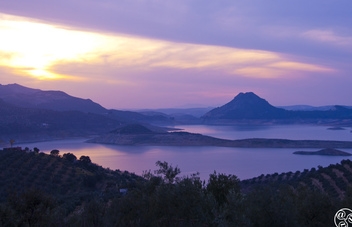
Iznájar was transformed some decades ago by the construction of an embalse (reservoir) below the promontory on which Iznájar sits in the River Genil valley. Today, Iznájar feels as though it has a waterfront overlooking an inland sea some thirty kilometres long, and containing an estimated 900 million m³ of water destined for domestic consumption.

Embalse de Iznájar

The reservoir is the largest in Andalusia, and, when constructed over ten years during the 1960s, the dam was was the largest in Spain, requiring 1.4 million cubic metres of concrete.

Vegas de Genil Festivals

Popular festivals in Vegas del Genil are Fiesta de la Virgen de los Remedios, Fiestas de la Merendica, Fiestas de San Marcos, Día de la Toma and Semana Santa.

Necrópolis and Los Algarbes

The Archaeological Complex of Los Algarbes lies southeast of Zagra, around the Cortijo del Algarbe, in an area of rocky limestone and sandstone formations containing numerous natural caves and rock shelters. The name Algarbe derives from the Spanish word “Algar” (meaning cave), reflecting the many caves and graves excavated in stone.

Zafarraya

Zafarraya is a village in western Granada province, near the border with Málaga, set at 893m on a fertile plain surrounded by mountains.

Salar

Salar is the source of the Bañuelo thermal springs, and is also home to the Monea caves featuring stalactites and stalagmites. From here, visitors can experience amazing panoramic views.

History of Zagra

Zagra has a history spanning more than 6,000 years, with evidence of human settlement from prehistoric times through the Neolithic, Iberian, Roman, Late Antique and Islamic periods.

Bus Service of Zagra

There are bus services from Zagra to Granada City and Algarinejo using the bus company, ALSA.

Book your stay in Andalucia Now!