Latest Pages

Latest pages

We are committed to updating our pages as regularly as possible, allocating over half of our editorial resources to this essential task, to ensure that you can always find the latest, most reliable information on popular topics and places.

Here is a list with the latest pages that have been updated or created. Most recent are at the top of the list.

Club de Playa Cabane Marbella

Part of the Hotel Los Monteros inthe exclusive Los Monteros urbanizacion east of Marbella, La Cabane provides all manner and size of luxury sunbeds and the prerequisite Champagne to complement the occasion. The atmosphere is exclusive and Mediterranean candle-lit dinners are a specialty here, along with live music at weekends.

Playa de San Pedro de Alcántara

This is the long straight and wide beach backed by a seafront promenade, cycle path and a quiet urban access road. This beach is never crouded due to its size. The beach offers full services including a Red Cross first aid post.

History of Lentegí

In 1933, a prehistoric necropolis was discovered in the area known as Umbría Tinajas, belonging to the Argaric bronze age; the remains are currently in the Archaeological and Ethnological Museum of Granada.

Sabicas

Augustín Castellón Campos or Sabicas as he was artistically known, was the first and probably the most well-known flamenco guitarist outside of Spain. He was born in Pamplona in 1913, although like many gypsy artists there is much speculation over his date of birth and some put it at 1907.

Club de Tenis Nueva Alcántara

The Nueva Alcántara Paddle and Tennis club has four grass tennis courts and 11 paddle tennis courts, of which five are glass walled. The club is in partnership with the Hotel Guadalmina, the official hotel of the Paddle Protour circuit and is converted into the headquarters of the World Paddle Championship each year.. Other facilities include a gym, fitness centre, spa, beauty centre, boutique and bar/restaurant.

Cortelazor

The old centre of this tiny, ancient hilltop village, stunningly located within the Parque Natural Sierra de Aracena y Picos de Aroche, has been declared of Cultural interest. Cortelazor itself was founded in the mid-13th century, and these days its economy is based on livestock.

Victoria Hislop

That same sunshine that attracts so many of us to Andalucia also drew Victoria Hislop to Granada in search of a story of love, passion and tragedy as she researched Spain’s Civil War. The Return is an historical novel set between present and past.

Huétor Santillán

The proximity of Huétor de Santillán to Granada city does not stop visitors from enjoying the great outdoors; the town is located in the Sierra de Huétor natural park, which gives the village its name. Huétor de Santillán was originally a Moorish town, and its narrow streets haven't changed much since then. In the village centre you'll find its grandest monument: la Iglesia parroquial de la Encarnación.

History of Caminito del Rey

The original path was built between 1901 and 1905 by the Sociedad Hydroelectrica del Chorro (Chorro Hydroelectric Society). A pioneering project to take advantage of the 100m drop in the river Guadalhorce required the construction of a small dam.

Bullfighting - Fascinating Facts 2

The origins of bullfighting are probably in the man v beast contests of the Roman gladiators. Even earlier, Palaeolithic paintings found in Spain depict men fighting bulls and other wild animals. In Greek legend, you have Theseus and the Minotaur, a half-man half-bull, while a Babylonian legend has its hero slaying a bull by thrusting his sword "between nape and horns". But there are also strong links with the popular Moorish pastime of rejoneando, where a rider would confront the bull using a (lance) in an arena (picadores in modern-day Spanish bullfighting). Portugal holds rejoneo bullfights where cavaleiros, who wear 18th-century dress and ride padded horses, are the stars, rather than the matadors, as in Spain. In Portuguese bullfights, the bull is not killed in the ring.
History - Phoenicians to Carthaginians

During the 11th century BC, the first contacts between the Phoenicians and Iberia were made. This lead to the emergence of towns and cities on the southern coast including Gadir.

Lobras

Lobras is a small village with its distinctive own personality. It feels as if time has stood still when you walk along its streets and visit its monuments. The location also means that visitors can enjoy tranquil landscapes and amazing natural beauty.

Apartments

Like other forms of accommodation in Lanjarón, and generally the Granada province, apartment rentals are generally reasonably priced and set in a beautiful surrounding. None of the featured apartments are located right in the centre of the village, however most are less than a km and so just require a short walk to the heart of Lanjarón.

History - Tartessos

For centuries Tartessos was as mythical as Atlantis and had just asWmany legends woven around it — but whether it was a city or an independent state, no one knows. The Greek historians Herodotus and Ephorus, plus Strabo the geographer, all wrote about Tartessos. The Roman historian Pliny the Elder indicated that Cádiz and Tartessos were really the same city but, although, the knowledge of early historians seems incomplete, they were all agreed that Tartessos existed.

Setenil de las Bodegas

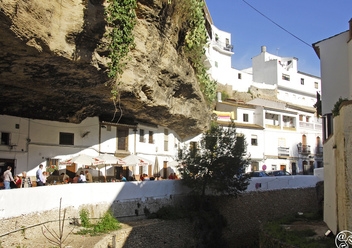
Named after its once flourishing wineries - bodegas - Setenil is probably unique among the pueblos blancos, white villages, of Andalucia. Where most pueblos blancos were built on protective bluffs and pinnacles, this town grew out of a network of caves in the cliffs above the rio Trejo north-west of Ronda.

Book your stay in Andalucia Now!