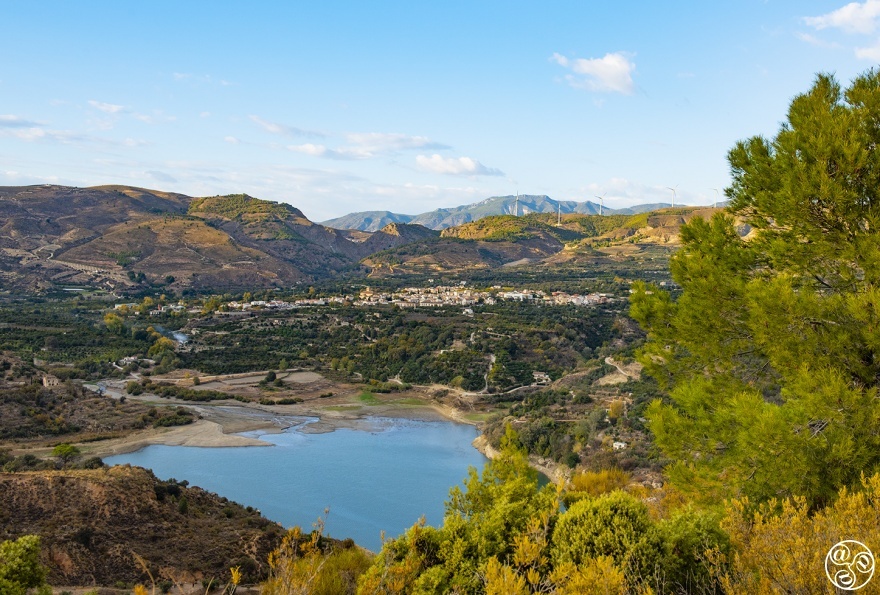
 Melegís, where the Nazari court (Moorish rulers of Granada) resided briefly in the 14th century, is situated on the Torrente river
Melegís
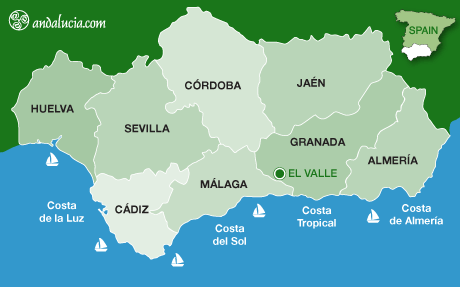
Melegís is one of three villages that were merged in 1972 to form a municial district called El Valle. The other two villages are Saleres and Restábal. Restábal as the larger and being located between the other two is 'capital' village and is where the town hall offices are located.
Melegís, where the Nazari court (Moorish rulers of Granada) resided briefly in the 14th century, is situated on the Torrente river. El Baño thermal springs offers waters renowned for their curative properties - above all, for skin disorders. Among its numerous noble houses the Iglesia de San Juan Evangelista stands out from the crowd. This church, which has recently been declared a National Monument, was built in the 16th century and is home to works of great value, such as a Virgen from the school of Alonso Cano, an old organ and a baroque-style Christ figure from Peru. Its structure you can see many Moorish style elements as well as renaissance and baroque elements. You shouldn't miss the 13th century Moorish mirador (watch tower) - there is also a newer viewing terrace in honour of all the émigrés who went to France and Germany in the 1950s and 60s - or the old public washrooms.
THINGS TO SEE
Mirador de las Alvirillas
The viewpoint was built in tribute to the emigrants who, in the 1950s and 1960s, left their beloved valley to seek work in countries such as France, Germany and Switzerland. Built in 2005 by the sculptor Elena de Vicente, the balcony is adorned with a variety of imaginative and colourful sculptures inspired by the stories and experiences of these emigrants. From the viewpoint, visitors can take in the tail of the Béznar reservoir, the Sierra Nevada, the El Valle countryside and the towns of Melegís and Pinos del Valle. These views are combined with the fantasy of a doll's house and contemporary art. It is located on the GR-3204.
Lavadero Público
Before the construction of the drinking water and sanitation network in 1974, women in the municipality used this washhouse to wash and rinse clothes. The building's design is based on traditional Granada architecture, and some claim that the current stone structure is not the original. It has a washing trough with flat boards raised up to waist height. Part of the roof is supported by painted poplar wood in an attempt to preserve it from moths. Now practically unused, the washhouse is located in a beautiful, rustic setting and is decorated with traditional plates on the wall, dating back to the time of the Bastetanos over 2,500 years ago. It is located on Calle Generalife.
Iglesia de San Juan Evangelista
Built in 1560, the church is one of the most interesting examples of religious architecture from the period of Granada's repopulation, befitting one of the Lecrín Valley's most important towns. The bricklayer Bartolomé Villegas and the carpenter Francisco Hernández were responsible for its construction, while Pedro Gómez de Fontefría designed the carpentry for the corners, cornice, steps and doorways. Having burned down during the Moorish revolts, the original framework was rebuilt by the carpenter Antonio López Camudio at the end of the sixteenth century. The structure incorporates elements of Mudejar, Renaissance and Baroque styles. The tower, with three bodies plus the bell tower, rises to the right of the chevet. Its openings have spandrels with tiles made by Francisco Fernández. The church also stands out for the artistic works it houses. These include a Virgin from the School of Alonso Cano, a baroque altarpiece, a baroque Christ from Peru, and an organ. It has been declared a Site of Cultural Interest. It is located in Plaza Eduardo Rebollo Aranda.
GASTRONOMY
Local produce includes olive oil, wine, beans, oranges and lemons. On the first Sunday of every month, the Lecrin Valley farmers' and artisans' market takes place.
Traditional delicacies of El Valle include puchero de hinojos (fennel stew), pisto de calabaza (ratatouille with pumpkin), ensalada de pimientos coloraos (pepper salad), caracoles en salsa (snails in sauce), manos de cerdo (pigs' trotters) and albóndigas de bacalao (cod meatballs). For dessert, try leche frita (flour, milk and sugar fried and rolled in sugar), crema de naranja (orange cream), torrijas (French toast) and pastas de almendra (almond pastries).
The Feria del Citrico (Citrus Festival) is held in Melengis ever year in the week before Semana Santa, with the Festival de la Naranja taking place on the Saturday before Palm Sunday.
FIESTAS
The main fiesta celebrated in El Valle is la Fiesta de San Antón, in June in Melegís. As well as religious events, at night there is a lively festival. In May the Romeria del Cerro is celebrated, in honour of the Virgen de Fatima.
DIRECTIONS
El Valle is 39km from Granada city. Take the A-44 (direction Armilla-Motril), then leave at exit 160 for Lecrín-El Valle, to join the GR-SO-24 and then finally the GR-110 which takes you to the centre of Restábal.