Private Excursions from Puerto Banus
See below for a selection of private group or family excursions from Puerto Banus. A perfect opportunity to see the main attractions in Andalucia without the hassle of organising it yourself.
See below for a selection of private group or family excursions from Puerto Banus. A perfect opportunity to see the main attractions in Andalucia without the hassle of organising it yourself.
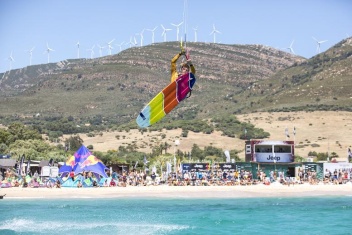
Each year many top Spanish and international kite surfers join beginners in Tarifa keen to try out this sport, which started in the 1990s. An international championship is usually held in the early summer in Tarifa,
Since the sport can be potentially dangerous, with boards moving along at up to 80km/h, surfers and bathers are separated by yellow buoys on Tarifa’s beaches. Two kitesurf zones along the beaches to the north of Tarifa are strictly enforced in the summer when the beaches are crowded with bathers. In the winter, rules are more relaxed.
Since the sport can be potentially dangerous, with boards moving along at up to 80km/h, surfers and bathers are separated by yellow buoys on Tarifa’s beaches. Two kitesurf zones along the beaches to the north of Tarifa are strictly enforced in the summer when the beaches are crowded with bathers. In the winter, rules are more relaxed.
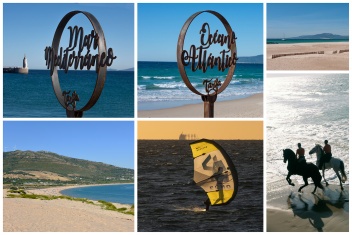
Playa de los Lances (Hotel Dos Mares)
Surfers have to pay close attention to up-to-date wind reports from websites such as Wind Guru, although kites can be flown in lighter winds than for windsurfing. The best kitesurfing months are May to November.
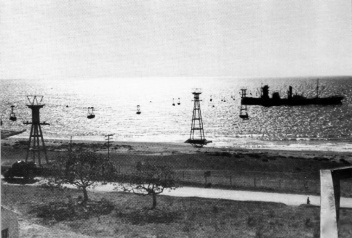
Playa el Cable (Cable Beach) takes its name from the overhead cable "El Cable Teleferico" runway that transported buckets of iron ore down from the Peñoncillo mine on the Sierra Blanca to ships moored offshore. If you look out to the sea you can't miss seeing the large anchor end tower of the line.
Located next to Andalucia's first skyscraper, the 180m-Torre Sevilla (known locally as Torre Pelli), CaixaForum Sevilla covers 8,100m2, consisting of two exhibition halls, an auditorium, two multi-use rooms, a Kids Zone room for children's activities, a shop, and a café-restaurant with outdoor terrace.
Festivals in Carmona: Cabalgata Reyes Magos, Carnaval, Semana Santa, Las Mayas, Feria, San Juan, Romería de la Virgen de Gracia, Fiestas Patronales and Romería de San Mateo.
Carmona is involved in the 'Ruta de la Tapa', a gastronomic tapa route to promote Andalusian cuisine. Restaurants involved in the route are signposted with a blue and white tile with the logo of the city. Typical dishes to try include sopa de picadillo (stock with jam and egg), caracoles (snails), migas (fried bread).
The Alcázar is of Muslim origin and was the residence of King Taifa of Carmona. It was restored several times after the re-conquest and Pedro I of Castile restored it in the thirteenth century. The earthquake of 1504 affected the palace and since then the ruin has been progressive and is now a gracious if expensive Parador. Located on Calle Los Alcázares.
Carmona is one of the most historic cities of the province. Its different denominations proclaim the role of the city in the different invasions. Its name is of Semitic origin, 'Kar' meaning 'city', and is explained by its probable Phoenician foundation. The Romans called it 'Carmo', and the Arabs 'Qarmuna'.
Puerto Banus tourist office is located near the marina in Plaza Antonio Banderas. It is a modern looking building opposite McDonalds on the corner of Avenida de Julio Iglesias and Calle Jos'e Saramango. It is open every day.
Many of these casa palacios, or mansions, look quite ordinary from the outside - perhaps as impressive entrance arch, but nothing else to make them out. Inside, you find beautiful arcaded patios with grand stone columns and potted plants.
When visitors see the magnificent baroque entrance to this vast stone building, most assume they're looking at yet another of Seville's palaces or grand residences. In fact, its origins are more prosaic: a tobacco factory, albeit one of Spain's largest buildings.
There are about 100 different watchtowers (Torre Vigia or Torre Atalaya or Torre Almenara) along the coast of Southern Spain. Some are of Moorish origins others from date from the later Christian re-conquest period. All with the purpose of looking out for invaders from the South. They have lasted the centuries with remarkable strength.
Located in Barrio Santa Cruz, in a pretty square with orange trees, the 17th-century baroque hospital was built to care for elderly, impoverished and infirm priests. From 2027, it will be used as a gallery for religious art, and offers a peaceful haven in this area which is often thronged with visitors.
The square - or rather a traffic roundabout - at the start of the Golden Mile was named after one of Marbella's founders, local priest Monseñor Rodrigo Bocanegra (1908-1972).
There was a small Roman town here on the Coast called Silniana. The Roman bathhouses can be seen in Guadalmina Baja and the Roman villa in Río Verde. There is also a Byzantine Early Christian Church of Vega del Mar.
In and around Sotogrande there are several commercial centres, markets, banks, pharmacies, cash dispensers etc.
Here we have categorised the wide range of restaurants in Sotogrande into the respective areas in which they are found, for example the well renowned marina and the Galerias Paniagua (Avenida Paniagua), as well as the neighbouring villages of Torreguadiario and Guadiaro.
Just west of the Costa del Sol in Cadiz provinceand a district of San Roque municipality. Sotogrande is about one and half hours drive from Málaga Airport, on the AP-7, and one and half hours from Jerez Airport and 45 minutes from Gibraltar airport.