Jaen City - Fiestas and festivities
The people of Jaen make every typically Andalusian festival unique to Jaén, thanks to their own variations on the traditions.
The people of Jaen make every typically Andalusian festival unique to Jaén, thanks to their own variations on the traditions.
In Spain, the equivalent of All Fools' Day is “Día de los Santos Inocentes”, which takes place in the middle of the long Christmas season (Spanish Navidad runs all the way through to 6 January, the Epiphany). On 28 December it’s your turn to play your favourite jokes on friends and family!
Foreign currency issues can have a significant impact on the cost of your purchase. In securing property abroad, purchasers are likely to spend more time searching for the right property via their estate agent and researching the best method of financing their purchase rather than considering the financial implications of transferring money overseas. The transmission of funds for property acquisitions is often done at the last minute. This leaves the buyer exposed to the prevailing exchange rate and can significantly alter the eventual total cost of the property.
Looking for financial information dealing with Andalucia? Doing business in Andalucia can be a little intimidating, especially if you are new to the region or even new to Spain. Many of the laws are as different as the culture so it is always refreshing to know that you can find trusted information all in one place.
Many people come to Andalucia, especially to the Costa del Sol, to make it their home. If you're thinking of moving to this part of Spain, you will need somewhere to stay while you look for your new apartment or house. In this situation, you'll be looking for a long-term rental.
Palacio de Congresos y Exposiciones Hospital San Juan de Dios conference centre has 7 rooms and capacity for 510 people. The largest room has the capacity of 150 people.
This route takes you from the coastal city of Malaga, southwest along the coast to San Pedro, then inland up the spectacular mountain road to Ronda. Next, you continue to Algodonales, which is also in the Sierra de Cadiz, before heading southeast down to the plains, and over to Jerez, home of sherry, flamenco and beautiful horses.
This route takes you from the coastal city of Malaga, south-west along the coast to San Pedro, then inland up the spectacular windy mountain road to Ronda. Next, you to continue to Algodonales, also in the Sierra de Cadiz, before heading south-east down to the plains, and over to Jerez.
Itinerary: Malaga - Velez Malaga - Competa - Frigiliana - Nerja - Malaga - (day trip or 2 days)
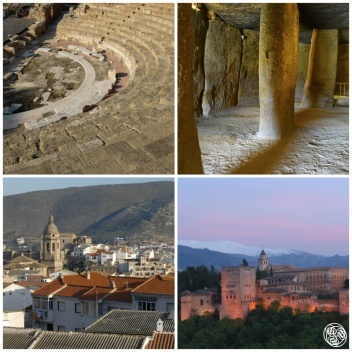
Itinerary: Malaga - Antequera - Loja - Granada - (2 days). Leave Malaga heading north on the A45. You will drive through the Parque Natural Montes de Malaga. When the road forks, head left to Antequera. This is a small, ancient town with Roman , Moorish and Bronze Age remains, including two important dolmens.
The Church and Convent of La Concepción, dating back to 1655, is one of the oldest in Guadix. Despite suffering several fires, it retains its original 16th-century structure with a central cloister and arched galleries. Beneath the street lie the remains of Roman baths from the city’s ancient past. It is located on Calle Concepción.
The Palacio de Peñaflor belonged to the Pérez de Barradas family, Marquesses of Cortes and Graena, who settled in Guadix after the Reconquista. The building is currently being considered for conversion into the town’s future museum. It is located on Calle Barradas.
The Church of La Magdalena, located in the historic neighborhood of the same name, holds great historical and architectural value. Built from the mid-16th century on the site of the former Mozarabic community, it preserves Mudejar features such as wooden roofs and a typical Accitan bell tower, as well as a Baroque portal from 1621. Recently restored, it now houses the Diocesan Archive of Guadix and part of the town’s treasures.
The Antigua Lonja, or Old Exchange, once served as a centre for business meetings, commercial transactions and banking in Guadix. Today, only the façade remains, featuring the coat of arms of Charles V, indicating that the building was constructed between 1530 and 1550. It is located on Calle Ancha.
The Roman Theatre of Colonia Iulia Gemella Acci is one of Guadix’s most remarkable archaeological sites. Built in the early 1st century AD, the theatre formed part of a monumental complex covering almost 6,000 m² and served as a leisure space for the Roman colony founded by Julius Caesar. It is located on Avenida Mariana Pineda.
Guadix is considered the ‘European Capital of Caves’ due to its 2,000 underground dwellings spread across 200 hectares. Around 4,500 residents still live in these cave houses, which maintain a constant temperature year-round and offer peace and quiet thanks to their natural clay insulation. The caves are easily accessible from the town centre.
The Cathedral of Guadix, built on the so-called ‘Sacred Hill’, stands on the site of a former Visigothic cathedral and later an Arab mosque. Constructed between the 16th and 18th centuries, it is the town’s most important monument, combining Gothic, Renaissance and Baroque elements. Its most famous feature is the Puerta de San Torcuato, with its tall bell tower visible from anywhere in the town.
The Palacio de Villalegre is one of Guadix’s most emblematic buildings. Built by the Fernández de Córdoba family on the site of a former Muslim residence, it later passed through several noble families. Over the centuries, it has served as a Civil Guard barracks, a tenement house and local police headquarters. It is located on Calle Santa María del Buen Aire.
The Church of Santiago, designed by the architect and sculptor Diego de Siloé, is one of the most beautiful examples of religious architecture in Guadix. Built on the model of a traditional Mudejar temple, it features a monumental Renaissance portal, whitewashed walls, and a ceramic spire. It is located in Plaza Santiago.
The Casa Consistorial, or Town Hall, represents the transformation of Guadix into a true Renaissance city. Originally built between the late 16th and early 17th centuries, it centralised political power around the main square. After being destroyed during the Spanish Civil War, it was rebuilt in 1949. It is located in the Plaza de la Constitución.