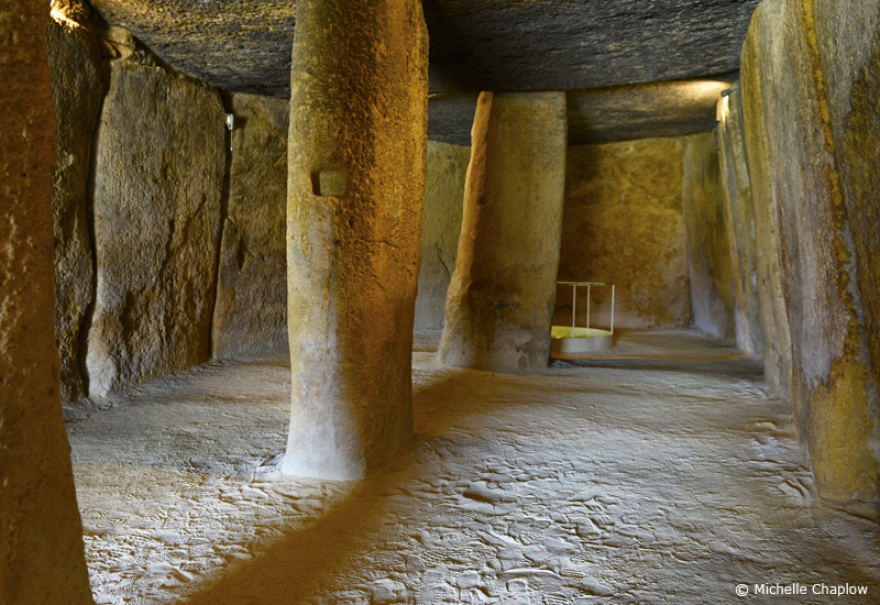
 La Menga Dolmen, Antequera (click to enlarge image) © Michelle Chaplow
Prehistoric
There is much illustrated information available in museums throughout Andalucía about the life and culture of prehistoric man. This has generally been pieced together through archaeological discoveries of their tools and household goods; but of prehistoric architecture little remains.
Dolmens are megalithic tombs dating back to 2,500 BC. Generally constructed of three gigantic pieces of stone, one horizontal resting on two uprights, these formed the entrance to a collective burial chamber that was then covered by earth.
The Dolmen de Menga near Antequera is the most spectacular example that has been discovered in the Iberian peninsular.
The ‘Tumba del Gigante' near El Gastor in Cadiz province is another fine example.
Bronze Age tombs from around 1,900 BC have been found in the foothills of the Sierra de Gádor (Almería), just outside the remains of the walled settlement of Los Millares. Within the walls, there is evidence of groups of simple, round dwellings and a large building used for copper smelting.
El Dolmen de Soto is a megalithic monument dating from 3000-2500 BC in the form of a 20.90m corridor found in 1923 by Armando de Soto, dating to the Copper Age. Located outside Trigueros.
Few architectural monuments exist until the Phoenicians settled in Andalucía around 1,100 BC. They were not invaders but traders who established factories and buildings for storage along the Mediterranean coastline, in particular near Cádiz, the gateway to the Atlantic. Vestiges of one such factory, used by the Phoenicians then developed by the Romans for the processing of garum, a kind of fish paste, can be seen at Bolonia.
Another Phoenician and later Roman in the centre of Cádiz city was a fish salting factory located under the former Teatro Andalucía demolished in 1995. Part of the salting factory has been fully conserved in the basement of the new building. Address: Calle Sacramento 16 behind Calle Guerra Jiménez. .