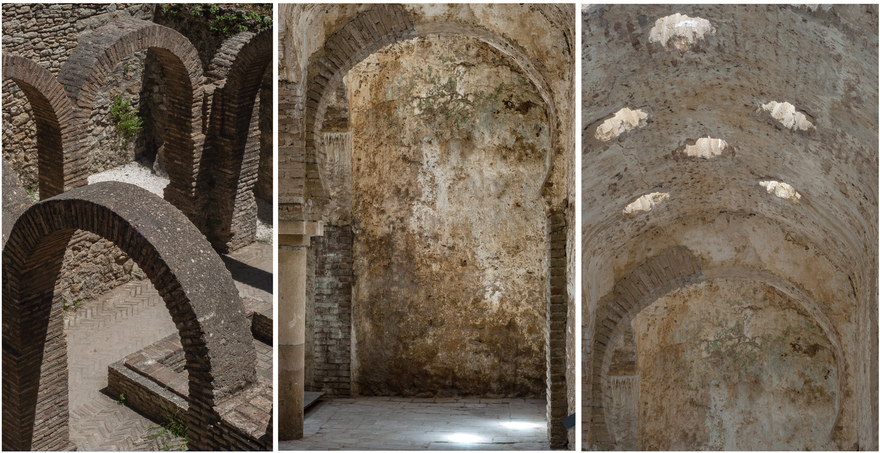
 Andalucia Arab Baths of Ronda
Baños de los Arabes (Arab baths)
Explore the Arab Baths of Ronda, Málaga, one of Andalucía’s best-preserved Islamic hammams. Discover centuries-old architecture, star-shaped skylights, and underground chambers that once hosted the city’s main Moorish baths.
A Hidden Treasure in Ronda, Málaga
In the historic heart of Ronda, Málaga, are the Arab Baths of Ronda (Baños Árabes) are among the best-preserved examples of Islamic hammams in Spain. Reached by a short walk from the Puente Viejo and the Palacio de Salvatierra, the baths are accessed via a series of rudimentary stone steps that lead down toward the Arroyo de las Culebras. Partly hidden among old walls and gardens, these underground chambers offer a fascinating glimpse into the daily life, architecture, and engineering of Moorish Ronda.
Origins and Historical Significance
The baths are believed to have been built in the late 11th or early 12th century, during the Almohad or early Nasrid period, when Ronda was an important stronghold of al-Andalus. Serving as the city’s principal public hammam, the baths played a key role in ritual purification, social life, and relaxation.
Interestingly, the baths lie just outside the old city walls, indicating they were used during peaceful times when citizens could safely move beyond the fortifications. Over the centuries, floods and neglect buried parts of the complex, but excavations and restorations have revealed the chambers we see today.
Architecture and Layout
The Arab Baths follow a traditional Moorish layout inspired by Roman thermal baths but adapted to Islamic customs. Visitors would have moved through three main rooms:
- Cold Room (al-bayt al-barid): To refresh and prepare the body.
- Warm Room (al-bayt al-wastani): A transitional space.
- Hot Room (al-bayt al-sajun): The main chamber for bathing and steam cleansing.
Water was originally supplied from two nearby streams and raised into the baths via a waterwheel and underground channels. Furnaces beneath the floors heated the water and generated steam through a hypocaust system, creating a warm, soothing environment.
Star-Shaped Ceilings and Symbolism
One of the most striking features of the Arab Baths is the domed ceilings pierced by star-shaped skylights. These openings provided both natural light and ventilation, casting a soft, celestial glow throughout the chambers. In larger baths in Seville and Granada, similar skylights incorporated astronomical symbolism, linking the heavens to daily life — a tradition echoed in Ronda’s hammam.
Decline, Restoration, and Modern Use
While the baths’ original mechanical systems have vanished, the underground chambers remain remarkably intact. Restored sections occasionally host classical music concerts, taking advantage of the space’s natural acoustics and atmospheric vaults. Visitors can walk through the cold, warm, and hot rooms, experiencing firsthand the engineering skill and architectural elegance of medieval Ronda. They are also the final destination of the Tajo Gorge walkway.
A Lasting Legacy of al-Andalus
Today, the Baños Árabes de Ronda stand as a testament to the city’s rich Islamic heritage and its role as a cultural crossroads in Andalucía. The combination of subterranean chambers, flowing water, and starry ceilings offers a serene journey into history, where architecture, technology, and culture converge in one remarkable site. For anyone visiting Málaga or Andalucía, the Arab Baths of Ronda are an essential stop to connect with the region’s layered past.
Location
Calle Molino de Alarcón, Ronda
