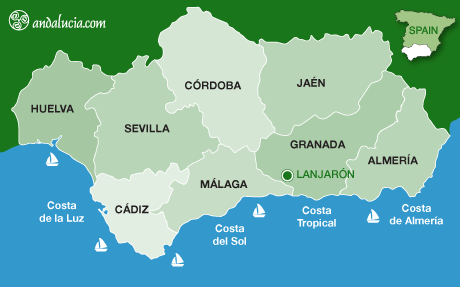
Lanjarón
by Saskia Mier
Lanjarón is the first town you come to in the Western Alpujarras, considered the gateway to the region. It is famous for its mineral water which is sold throughout Spain, while its spa waters have been celebrated for centuries for their curative properties and are considered to be some of the best in the country. It has a population of around 3800 inhabitants.
History
Lanjarón appears clearly in history under the dynasty of the Alhamares, around 1231. Historians such as Ginés Pérez de Hita and Diego Hurtado de Mendoza believe that it was during the tenth century when two Mohammedan tribes led by two Moors Joraidan and Gil “El Barbari” arrived in Lanjarón, which caused a demographic growth and an improvement in the existing structures: promotion of agriculture and livestock, a new irrigation system, flour mills, bakery ovens, lime and plaster mills, esparto and silk industries were created, thus initiating an economic take-off in the area. More>
Book Holiday Rentals in Lanjarón

Things to see
Balneario
From the mid-nineteenth century onwards, the therapeutic properties of water would significantly alter the appearance of the town and the lifestyle of its inhabitants. By the end of the century, there were numerous affordable accommodation options in private homes and rooms for modest families, as well as three inns (La Granadina, San Rafael and Reguera), which were classified according to travellers' preferences and experiences. From the 1920s onwards, the Lanjarón spa experienced its most glorious era. More>
Iglesia de la Encarnación
The church was built on the site of an early mosque between 1555 and 1560. This mosque was later destroyed by the Moors and its reconstruction was delayed until 1603. The Ermita del Rosario was built in 1617, followed shortly by the Ermita del Buen Suceso. More>
Ermitas
Ermitas There are various small chapels throughout Lanjarón, such as the Ermita de la Virgen del Pilar, the Ermita de San Isidro, the Ermita de San Roque, the Ermita de San Sebastián and the Ermita del Tajo de la Cruz. More>
Pilares
There are up to 23 water fountains throughout the municipality that were used by ancient inhabitants to collect water for their homes. More>
Hornacinas
Hornacinas are arched niches that are usually cut into the thickness of a wall. In many cases, objects can be placed inside them. In this case, they are typically used to display religious items such as figures, paintings or symbols of different saints. More>
Cañones
The town has four cannons. The oldest is located at the entrance to the town and, according to legend, was used against the French. More>
Museo del Agua
The Water Museum is an archaeological project that has restored an old water mill inspired by the Alhambra. The exhibition spaces have been arranged through selective occupation. More>
Museo de la Miel
The Honey Museum is an interpretation centre dedicated to the conservation of biodiversity through beekeeping. Its aim is to create an open-to-the-public space for disseminating the history of beekeeping, bee biology, and hive products. More>
Things to see outside the town
Balneario
This is a fortified enclosure with a quadrangular floor plan, built using wide adobe and stonework. The 'donjon' style keep stands out on one of its sides. It has walls without towers, wide battlements and few barbicans. More>
Natural areas
Nature lovers will enjoy exploring sites such as the Parque del Salado, the Cabecera del Río de Lanjarón, the Castañar de la Huerta de las Monjas, the Cerro del Caballo, the Laguna Cuadrada, the Laguna de Barro, the Laguna de Bolaños, the Laguna de Nájera, the Laguna del Caballo, the Laguna del Lavadero de la Reina, the Tajo Colorado and the Travertinos del Valle del Río.
Handicrafts
Lanjarón crafters are experts in using wicker and other plant fibres to make all kinds of everyday utensils and decorative elements, such as baskets, hampers, armchairs, vases for the mineral-medicinal water at the spa, beds, bedside tables, trunks, cribs, Christmas trees, firewood racks and magazine racks, among others.
Bus service
There are bus services from Lanjarón to Granada and Motril. More>
Gastronomy
Typical dishes to try in Lanjarón are choto al ajillo (garlic stewed goat), cazuela serrana (pork and potato stew) and potajes (meat stews). Sweet treats include buñuelos (doughnuts), pan de higos (fig bread), borrachuelos (liqueur sponges) and barretas de miel (honey pastries).
Festivals
Popular festivals in Lanjarón are Fiestas de San Juan Bautista, San Sebastián, Semana Santa and Festival de Música Tradicional. More>
Weather Forecast
The weather forecast for the next few days for Lanjarón. More>
Tourist Office
The tourist office of Lanjarón is located in the Oficina de Tursimo. More>
Nearby Places
The neighbouring villages to Lanjarón are Soportújar, Vélez de Benaudalla and Nigüelas.
Like other forms of accommodation in Lanjarón, and generally the Granada province, apartment rentals are generally reasonably priced and set in a beautiful surrounding. None of the featured… More →