Seville
Jardin Americano
This botanical garden is full of species donated by countries in the Americas for Expo 92, and is divided into different areas, including palms, cacti (look out for the prickly pear, with its yellow flowers and reddish-yellow fruit), tropical and sub-tropical plants. Many succulents and other plants.
Jardines del Guadalquivir
Built more as a traditional park, this is very close to the Jardin Americano, but you need to know exactly how to get there, it’s not signposted (which means it’s quiet and little-visited): leave through the gate at the lake end, turn left walk and along next to the cycle lane.
Seville City Museums
Seville has many excellent museums representing a wide range of subjects, historical periods and styles.
Lope de Vega Theatre
This neo-baroque theatre is named after the famous 16th century Spanish playwright, often called the Spanish Shakespeare, who wrote more than 1,500 plays. Like most of the buildings in this area of the city, it was designed for the 1929 Iberico-American Expo as the Pavilion of Seville, and was later used as a casino. It was converted into a theatre in 1980.
Seville City Maps
If you are considering visiting Seville you may find our maps a useful tool, we provide three maps, one of the region of Andalucia with Seville highlighted. The second handcrafted map gives the location of Seville with the corresponding local road network
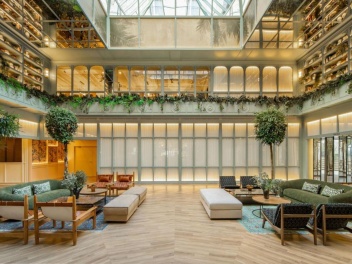
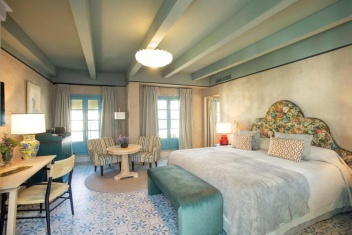
Hotel Casas del Rey de Baeza
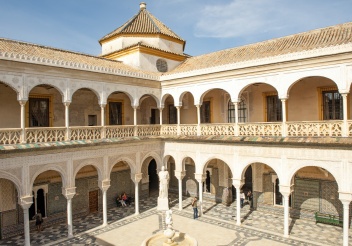
Casa de Pilatos, Sevilla
La Casa de Pilatos (Pilate's House) is the finest example of a civil (as opposed to royal) palace in Seville. The building is a mixture of Italian Renaissance and Spanish Mudéjar adorned with precious tiles, and has well-kept gardens.
Getting around
By far the best way to get around Seville is on foot. The narrow alleys, lack of parking and infinite one-way streets make driving complicated at best, highly stressful at worst. Best avoided, unless your hotel has a car park or garage.
Italica
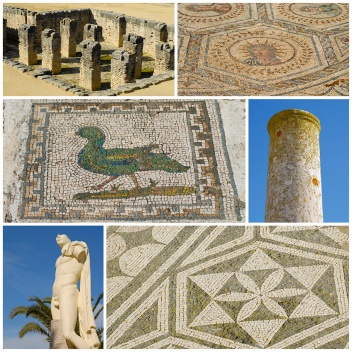
Roman ruins of Italica, near Seville, with remarkable mosaics and an impressive amphitheatre, are located 9 kilometres to the north of the city, just outside the village of Santiponce. Nearby you can also see a well preserved Roman theatre. Both are signposted from the the main road.
Museo Arqueologico Antiquarium
Situated in the basement of Metropol Parasol in Plaza Encarnacion, this is a modern, well-presented archaeological museum following a similar format to the Castillo San Jorge (Inquisition Museum), with sections of ruins visible through glass partitions, and underfoot along walkways.
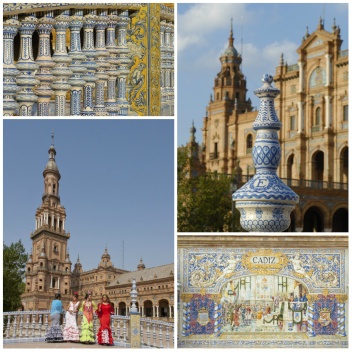
Plaza de España, Seville
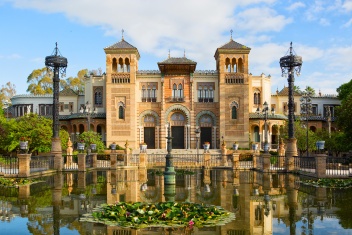
This massive building is Seville's most impressive after the cathedral, for its sheer scale and grandeur. Love it or hate it - fabulous or fussy, magnificent or overblown, depending on your point of view - you shouldn't miss it when visiting the city.
Castillo San Jorge: seat of the Inquisition and exhibition space
This castle once housed the headquarters of the Catholic Church's "Tribunal of the Holy Office of the Inquisition". The impressive remains, located underneath Triana market, are now used as a stunning exhibition space.
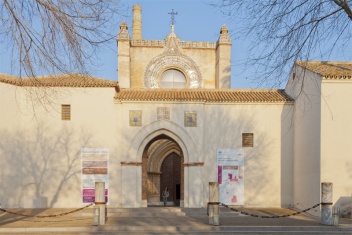
Monasterio de la Cartuja
This large, walled complex of honey-coloured stone buildings, situated on the Isla la Cartuja (named after the monastery itself; the word means “charterhouse”), has seen many ups and downs during its long, dramatic history. From monks who welcomed Christopher Columbus, to barracks for Napoleon’s troops, ceramic factory run by an Englishman producing world-renowned porcelain, to modern-day contemporary art gallery and open-air live music venue.
Seville City Archaeological Museum
One of the best museums of its kind in Spain, located in the Maria Luisa Park and originally built as part of the 1929 exhibition. The focus is on the Romans, but there is also a prehistoric section which includes the Stone Age, Bronze Age and Iron Age. Later, the Phoenicians, the Greeks and the Carthaginians all traded and settled in what is now the province of Seville.
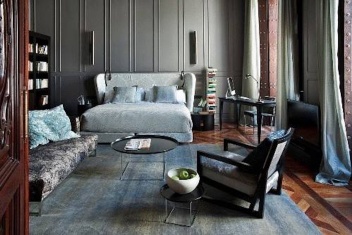
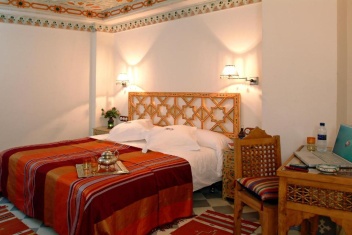
Hotel Alcoba del Rey
Triana district of Seville city
Famous for having its own strong identity - it's known in Seville as "the independent republic of Triana" - this district is celebrated for its azulejos (ceramic tiles), made in workshops here originally using mud from the river bank; its sailors, bullfighters and flamenco artists.
Macarena district of Seville City
Next to the Alameda, this is an authentic Seville barrio; although many houses have been restored and smartened up in recent years to attract young professional types, thankfully it hasn't gone too chi-chi. You'll find trendy clothes shops, of the street-style skateboarder variety, as well as artists' communities. The food market on Calle Feria is one of the city's best and the "El Jueves" Thursday flea market is fun for bargain-hunting. The area is home to one of Seville's two favourite Virgins, the Virgen de Esperanza, a focus of intense adoration during Semana Santa.
The Parish Churches of Seville
Seville's parish churches display a fascinating variety of architectural styles. Several are converted mosques with belfries built over their minarets, others range through Mudejar and Gothic (sometimes in combination), Renaissance and Baroque.
City Walls and Gates of Seville
As you arrive in the city, look out for remnants of ancient stone walls marooned in the centre of busy roads, plus an impressive, well-preserved 400-metre section in Macarena, near the Andalucian parliament building. These are the remains of the city walls, or murallas, dating from the 12th century - Seville was once the most strongly fortified city in Europe.