Seville

Museo de Bellas Artes

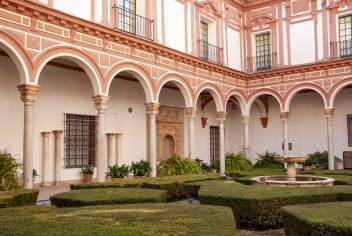
Once a convent, this magnificent art museum has been lovingly restored and is now one of the finest in Spain. Located in a tiny plaza away from the city centre bustle, the building dates back to 1612, the work of architect, Juan de Oviedo.

The Arenal district, Seville

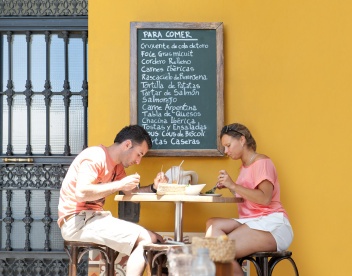
Tucked in between Avenida de la Constitucion and the river, El Arenal was home to the city's port, from where ships sailed to the New World - hence its name, from arena (sand), on the then-tidal river banks. These days, it's a well-heeled barrio with abacerias (shops selling conservas, tins and jars of food, and cheese), freidurias (fried fish takeways) and, as well as some good bars and restaurants.

Art Galleries

The two most important are the Museo de Bellas Artes and the Centro Andaluz de Arte Contemporaneo. One of the most prestigious of all Spain's Fine Arts Museums, the beautiful Museo de Bellas Artes is a former monastery and has a superb collection of art by Spain's most celebrated painters including Zurbarán, Murillo and Valdás Leal.

Festivals in Seville City

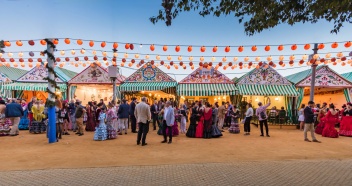
The first is Semana Santa (Easter Week) which is truly spectacular with extraordinary processions of masked penitents and carnival-style floats. People travel from across the country and around the world to witness this annual week-long event.

History of Seville City

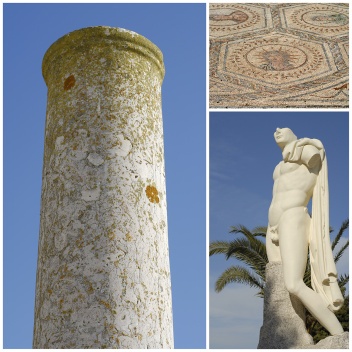
Seville has a long, rich and fascinating history. The Romans governed the whole of Spain for more than six centuries, their first colony, Italica, is close to the city, and can still be visited today.

Convents & Monasteries in Seville

Seville is a city rich with convents and monasteries. Groups of nuns scuttle down the streets going around their daily business and school girls, dressed in smart plaid skirts and shirts walk in single file throughout the city. Although there is restricted entry to many of the convents, most are inhabited by closed religious orders.

Hotel Casa 1800

The magnificent iron entrance gate tells you hotel’s name, in case you missed it. All the 24 rooms in the three-storey casa-palacio, built in 1864, are different. Casa 1800 has an unusual mix of décor, but it works – as you come in, the lobby has exposed brick (original, though rather out of place in an elegant palace), a chandelier, gold velvet-upholstered baroque furniture, parquet brick floors and a leather sofa.

Barrio Santa Cruz, district of Seville city

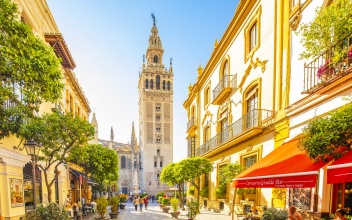
This is the first barrio (area or neighbourhood) tourists head for, and with good reason. The Barrio Santa Cruz is the most picturesque and delightful part of the city, with narrow winding cobbled streets and whitewashed houses, where you can sit outside a bar, enjoy some tapas and watch the world go by, or wander through centuries-old gardens and relax on beautiful tiled benches.

Palacio de Lebrija

One of the least known of Seville’s museums, this is a family palace with a wonderfully varied private collection. It is situated at the Campana end of Calle Cuna, parallel to Calle Sierpes. Look out for the impressive but discreet stone doorway (there is no obvious sign) and huge wooden doors.

Paseo de Cristobal Colon

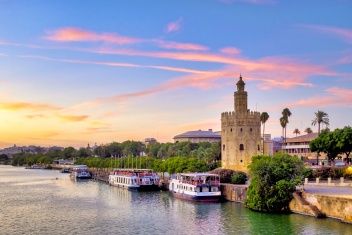
Back in Columbus' time the river here would be crowded with boats, nowadays the occasional tourist steamer chugs by or pedal boat. But it is still the most charming paseo which during the weekends is thronging with strolling lovers and Spanish families dressed in their Sunday best. The view across the river is quite beautiful with a row of typical Andaluz houses with wrought iron balconies.

Shopping in Seville

The main shopping area is the square between Plazas Nueva, Magdalena, Encarnacion and San Francisco, with Calle Sierpes at its heart. For more touristy gear (flamenco aprons, T-shirts, bullfighting souvenirs) Barrio Santa Cruz has a wealth of places; for more individual shops, Barrio San Vincente and the Alameda; while for ceramics, Triana is where the beautiful azulejos (ceramic tiles) which adorn many Sevillano bars, hotels, churches and private houses are made.

Hotel EME Catedral

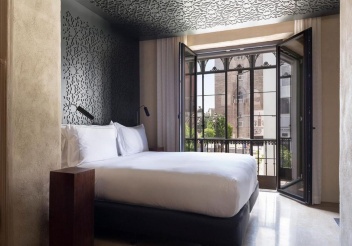
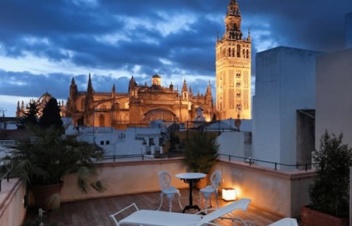
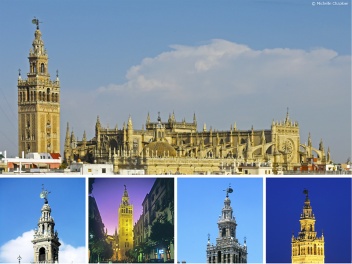
The EME Catedral was Seville's first designer hotel when it opened in 2008. With gold unisex loos, central patio with Arabic lattice celosia screen and 54 totally different rooms, it's in a class of its own; sophisticated but accessible. Some rooms have a view of the Giralda, while if you want to seriously splash out, the suites have private entrance, 24-hour butler and their own roof terrace with jacuzzi and/or pool.

Hotel Only YOU Sevilla (formerly Hotel Ayre)

If you’re making a visit to Seville, and then heading off by train to another Spanish city – connections to the Andalucian cities of Malaga and Cordoba are excellent, as are those with Madrid and Barcelona to the north, thanks to the regular high-speed AVE services – this is the place to stay.

Hotel Palacio de Villapanes

Hotel Palacio de Villapanes boasts a formidable entrance of pale-coloured stone, topped by a heraldic crest. Inside, a red marble floor and imposing black pillars lead to the patio; the 18th-century palace’s historic pedigree (it was built by the 1st Marques de Torre Blanca del Aljarafe; the Villapanes title was taken by a descendant) is further evident from another massive coat of arms on the grand staircase.