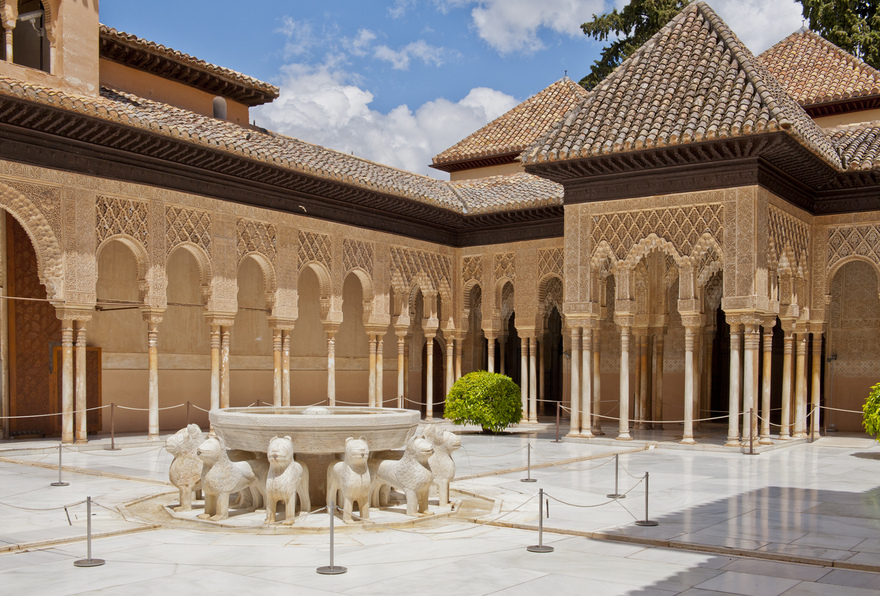
 Patio de los Leones is a highlight of any visit to the Alhambra.
Patio de los Leones
The Courtyard of the Lions represents the Garden of Paradise, a desert oasis of leafy palms surrounding a bubbling fountain. The rectangles between the marble walkways were, under the Moors, sunken gardens overflowing with flowers and aromatic bushes.
When the Christians arrived on the scene, they were amazed at the splendour of the Alhambra, which, by comparison with the harsh medieval fortresses in which their own monarchs lived, seemed incredibly luxurious. They called the most elegant part of it the "Room of the Lions", because of the curious fountain in its center - although its name for the Moors was the Palace of Mohammed V.
This late 14th century palace is the finest example of the hybrid style known as mudéjar, combining the intricate filigree and encrustations of Islamic art with the three dimensional, nature-inspired style of Gothic architecture. In many ways, this unique patio is similar to the Cistercian cloisters which the architects may well have visited in northern Spain.
Although it is not known precisely where the lions came from, the Moors themselves could not have made them because the Koran forbade the representation of living creatures, to prevent a return of the idolatry which it was the Prophet's first mission to stamp out. They were probably made by Christian or Jewish artists, and as such, they - and the portraits of the Nasrid Kings in an adjacent hall - are proof of the fact that by the 14th century the granadinos had become irreversibly Westernized in their habits and tastes.
The Court of the Lions is characterised by its profound originality, a harmonious merging of East and West. It has been compared to a grove of 124 palm trees, most with double columns, around the oasis of the central fountain with its twelve lions. The twelve-sided marble fountain rests upon the backs of the lions. Water, so essential as a decorative element acquires here an exceptional importance. It ascends and spills from the basin, which has been compared with the 'sea of bronze' of Solomon's Temple, to the mouths of the lions, from which it is distributed throughout the courtyard. A lovely "qasida" (ode) by Ibn Zamrak circles the rim of the basin.
Four large halls border the courtyard. The first, entering from the Court of the Myrtles, is the "Sala de los Mozárabes", whose name is perhaps derived from the three stalactite arches which form the entrance to the Court of the Lions. To the south is the "Sala de Abencerrajes", famous in legend with a gateway decorated with "lazo" (ornamental knots). Light penetrates the hall through 16 graceful fretwork windows. On the east side is the "Sala de los Reyes" which is unusual and resembles a theatrical set, divided in three sections which correspond to three lovely porticos, separated by double arches of "mozárabes" (stalactites).
The hall which faces the valley - the Sala de Mocárabes - was largely destroyed by the explosion of 1590, and rebuilt in an incongruously baroque style much later.
The hall which faces it, on the opposing, short side of the courtyard - the Sala de Reyes - is a gallery of open chambers used for summertime receptions. The Christians called it "the Hall of the Kings" because of the paintings in each of the domed ceilings of the three alcoves, one of which represents the Nasrid Sultans who had reigned when the palace was built. They were probably commissioned to a group of itinerant Italian painters, because Moorish artists were forbidden to create graven images.
The Sala de los Abencerrajes was so named by the Christians of Granada because, according to a well-known legend, the male members of a rival clan were slain there to avenge the Sultan, whose wife had been caught dallying with one of them. Be this as it may, the room was originally designed for the holding of receptions and banquets in the cooler months of the year, because it would have been easier to heat, with its fully enclosed interior.
The largest, and loveliest, of the halls is, undeniably, the Hall of the Two Sisters. This name refers to the massive twin slabs of marble which lie on either side of the central fountain, compared to two sisters in an Arabic poem. The adjoining hall is the "Sala de los Ajimeces" with two balconies overlooking the Garden of Daraxa. Between these two balconies is the "Mirador de Daraxa", dressing room and bedroom of the Sultana and a delightful retreat in this secluded section of the palace, in the style of a bay window or mirador.
Nowhere else in the Alhambra is there such a display of mocárabes, the encrustations with which the Moors coated archways and ceilings. These were pre-moulded in plaster and fitted ingeniously together to create the effect of stalactites in a grotto.
The Throne Room, similar to the one in the Tower of Comares, was set in a niche-like balcony, so that the light from behind would surround the Sultan in an aura. But romantic legend once more takes precedence: this enchanting place is known to all as the Mirador de Lindaraja - "lookout place of the queen" - for the wife of Sultan Muley Hacen who is said to have lived here. The balcony's windows overlooked the Albaicin on the other side of the valley, until the Christians built the rooms intended to accommodate Carlos Quinto on his visits to Granada, thus cutting off the splendid view forever.
The last hall gives access to the "Peinador de la Reina", also called the Tocador. An open gallery and an airy little tower, it was once designed as the residence of the Empress Isabel and later of Isabel of Parma. Some restored frescoes portray scenes of Charles V's expedition to La Goleta. In the Christian Alhambra Within the Alhambra enclosure there are also monuments which are exclusively Western. For example, in the "Jardines de los Mártires" there was once a monastery of the barefoot Carmelite order.
Here, as everywhere in the Alhambra, the walls are covered with tapestry-like plaster relief, in a seemingly endless variety of geometrical and abstract patterns. The panels are framed by holy texts from the Koran, carved by the Moorish masters in contrasting calligraphical styles which dazzle the viewer with their intricacy and elegance.
To stave off the final defeat, the Nasrids reluctantly agreed to be the vassals of the King of Castile, at the beginning of their reign in the early 13th century. Everywhere on the richly decorated walls of the palace we see the shield symbolically given to them by the Christians, which, defiantly, they inscribed with the Arabic words "The only conqueror is Allah".
The Courtyard of the Lions and its great halls, in spite of the erosion of time - almost all the rich colours with which the interiors were painted have disappeared - and the clumsy restorations and alterations performed in the past, stands as one of man's most singular artistic achievements. Alexander Dumas, who like many other European and American intellectuals made the pilgrimage here in the 19th century, likened it to "a dream petrified by the wand of a wizard".
Next page > Rooms of Carlos Quinto
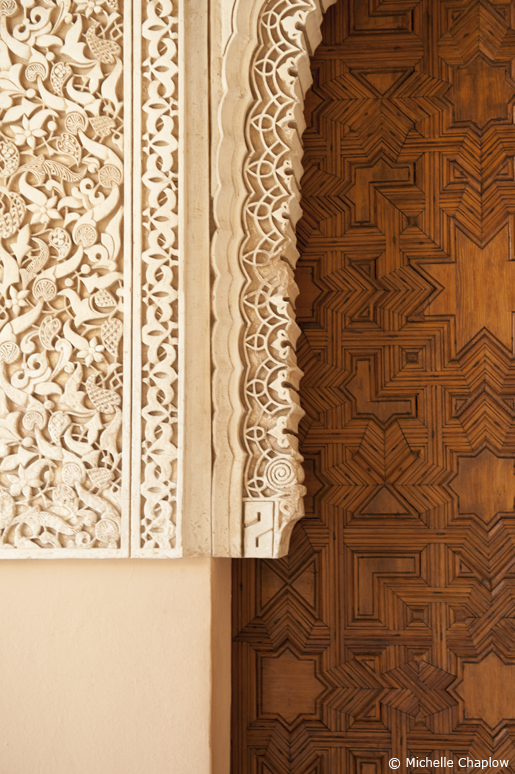 |
| The hand crafted stone carvings and woodwork are a joy to view. Such a fine example of Muslim Architecture. |
Buy your copy of - Granada, City of My Dreams
 Granada, City of My Dreams: An Historical and Artistic Guide to Granada and its Moorish Palace the Alhambra
This itinerary was written for Andaluca.com by Lawrence Boheme author of “Granada, City of My Dreams”. For, what fascinates us about this universal city is not only its monuments but its marvellous story, “the encounter between Moor and Christian, gypsy and Jew, medieval and Renaissance, glistening snow and Mediterranean sun. Lawrence Bohme, poet, illustrator and curious traveller, has filled these pages with luminous descriptions and drawings, the culmination of forty years of wanderings through the palaces and labyrinths. Amazon.co.uk or Amazon.es