DIEZMA
By Saskia Mier
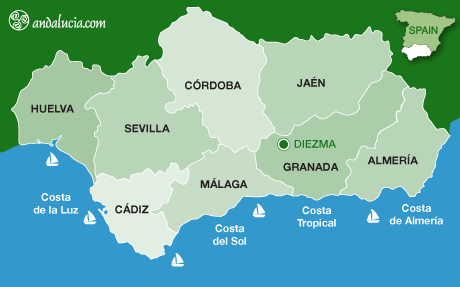
Diezma is a charming, historic village. With its traditional architecture and stunning landscapes, it is a must-see destination in Andalusia. The village has a population of around 900. It is located close to the A-92 motorway, to the east of Granada city.
HISTORY
The history of Diezma dates back to prehistoric times, as evidenced by the numerous remains found in the area. The first human settlements date back to the Paleolithic period, after which the region was successively inhabited by Phoenicians, Romans, and Visigoths. During the Moorish period, Diezma became very important as it was part of the Taha de Guadix, an administrative division of the Taifa of Granada under Nasrid rule. The town's elevated location gave it a strategic defensive advantage. More>
THINGS TO SEE
Iglesia de Nuestra Señora de la Anunciación.
The church was completed in 1545 by the stonemason Cristóbal Núñez, who carved his coat of arms into it. The church would ultimately become the centre around which the village was built. Over time, the church has undergone various modifications. The Moorish-style tower has a square base and rises two storeys above the church. The upper storey houses the bells. Attached to the church is a chapel where a tunnel, excavated during the Spanish Civil War, is located. This tunnel was used as a shelter and a safe access route to the parish church. The main altar is elevated by a few steps. The church is located on Calle Real. More>
Casa Solariega del Marquesado de Diezma.
An eighteenth-century building that was once the Marquisate’s ancestral home. The facade features a semicircular arched doorway and the artistic railings that enclose and protect its balconies and windows are the focal point of this building’s decoration. Located on Calle Real. More>
THINGS TO SEE OUTSIDE THE TOWN
Castillo de Peñas.
The fortress, also known as Castillo de Cabrera or hisn Qabrira, is mentioned in the eleventh-century chronicles of King Abd Allah. During the war against the Zirids, it was the only fortress in the Guadix area to remain in Zirid hands. The fortress is distributed over two levels that form separate enclosures. The lowest level is made up of adobe walls composed of lime and stone that fill the spaces between the rocks. Only the north-facing wall remains, which provides access to the complex. Located in the upper reaches of the Fardes River as it passes through Diezma, the fortress preserves remains of walls composed of large stones, as well as vestiges of a possible cistern. Fragments of stucco work can also be found on its walls. Several rooms excavated in the rock can also be seen.
NATURAL AREAS
Sierra de Huétor Natural Park.
Designated a natural park in 1989, the 12,128-hectare Sierra de Huétor is located just a few kilometres northeast of Granada, the capital of the province, and is therefore a popular weekend destination for city dwellers. This mountainous area boasts dramatic limestone features, including narrow ravines, steep cliffs, springs and caves such as the Cueva del Agua. The most famous spring is the Fuente Grande in Alfácar, which the Moors cleverly used as a source of water for Granada's Albaicín district, transporting it via an irrigation channel called the Aynadamar. More>
COUNTRYSIDE WALKS
Ruta de Ibn al-Jatib.
This route, which forms part of the Andalusian Legacy, follows the journey taken by Ibn al-Jatib, the last historian of Muslim Spain, from Murcia to Granada. He was born in Loja in 1313 and died in Fez in 1370. The route passes through the beautiful landscapes of the Sierra de María, north of Vélez Rubio and Vélez Blanco, and the Sierra de Huétor Natural Park, where the peaks offer stunning views of the Sierra Nevada. Passing through the province of Granada, the route takes in the municipalities of Caniles, Baza, Gor, Guadix, Purullena, Lopera, Diezma, Huétor Santillán and Granada.
HANDICRAFTS
Crafts are not very popular in Diezma, but they do work with esparto grass to make decorative elements that can be bought.
BUS SERVICE
There is a bus service from Diezma to Granada City. More>
GASTRONOMY
Diezma is paradise for lovers of great cuisine, offering a wide variety of dishes to delight your taste buds, combined with fantastic views of the Sierra Nevada. Diezma is also known for its extra virgin olive oil with a denomination of origin called Montes de Granada. Among the typical dishes you can try gachas (a traditional flour-based dish), sustentos (a potato, pork and sausage stew), gazpacho (cold tomato soup), olla de San Antón (chickpea stew) and plato alpujarreño (jamón, fried eggs, chips and fried peppers). For something sweet, try the piononos (syrup sponge).
FESTIVALS
Popular festivals in Diezma are Las Lumbres, San Blas and Fiestas Patronales. More>
WEATHER FORECAST
The weather forecast for the next few days for Diezma. More>
TOURIST OFFICE
The tourist office of Diezma is located in the Town Hall. More>
NEARBY PLACES
The neighbouring villages to Diezma are Purullena and Alfacar.