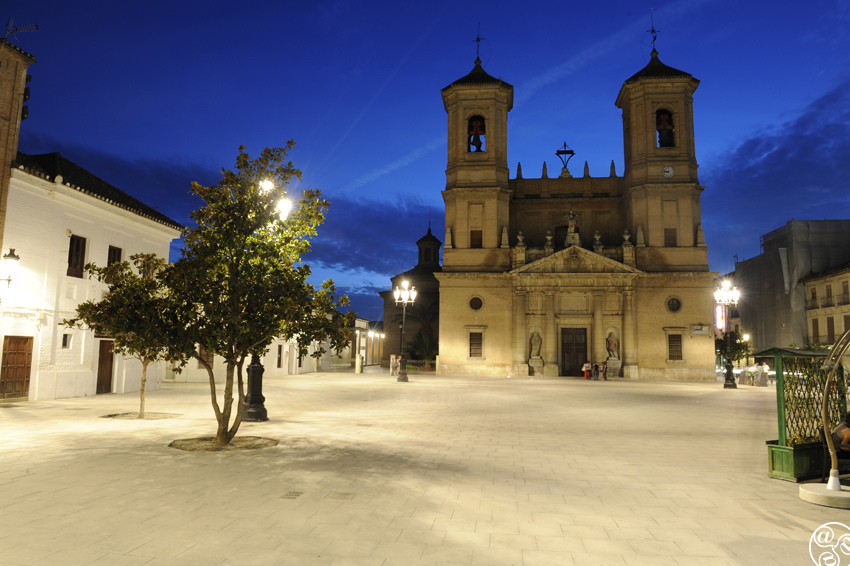
 Plaza de España, Church of Encarnación de Santa Fe
SANTA FE
Santa Fé, located in the fertile area of Vega de Granada (Granada Plain), is also known as the Hispanic Cradle. While it may not appear the most remarkable destination in Andalucía compared to the many pretty villages, towns and cities, it played a key role in Spain’s history. It began as an encampment set up by the Catholic Monarchs (Queen Isabella I of Castile (r. 1474–1504) and King Ferdinand II of Aragon (r. 1479–1516)) at the end of the 15th century, when the siege of Granada (c.1490-1492) commenced. The town’s structure follows the form of a cross based on two roads that cross at the centre. It has approximately 15,000 inhabitants.
History
In its beginning, Santa Fé was a military camp that occupied an area of approximately 48ha, planned by the Catholic Monarchs for the final assault on the Nasrids of the Kingdom of Granada. The camp was built in just 80 days, including several towers (notably the Tower of Santiago, on the eastern wall of the enclosure), walls and a moat around it, as well as four doors that still exist today, called the four arches or doors, each of them with its own name. More>

Things to see
Iglesia de Nuestra Señora de la Encarnación
The neo-classical style church was built in the 18th century. Construction began on 10th February
1774 on the site of a small temple built by the Catholic Monarchs but destroyed by an
earthquake. The construction plan was drawn up by Ventura Rodríguez (1717–1785 Spanish
architect and artist), although the work was commissioned to the architect of the Royal
Academy of San Fernando, Domingo Loys de Monteagudo. The construction took nine years
to complete
On the upper cornice of the church’s facade is the stone head of the Moor Tarfe, as well as a stone plaque commemorating the signing of the Capitulations of Santa Fé. In addition, the church has several details alluding to the city’s founding period, such as the two statues representing the Catholic Monarchs, Fernando and Isabel, which guard the church’s main door. Inside, there are four shrines, each with statutes of San Agustín (St Agustin, Patron Saint of Sante Fé), Nuestro Padre Jesús Nazareno (Our Father Jesus of Nazareth), Nuestro Padre Jesús (Our Father Jesus) and Nuestra Señora del Rosario de Fátima (Our Lady of the Rosary of Fatima). Located in Plaza de España.
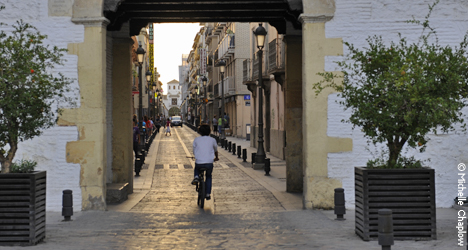
Las Puertas
Surrounding the camp was a strong wall reinforced with towers to defend the city, with Las
Puertas (The Doors or Gates) as the only entrance points. All that remains today are its four
doors (puertas), Puertas Jaén, Granada and Sevilla. Puerta Jerez was rebuilt in 1950 and is
now called Puerta Loja. Over time they have undergone different transformations, restructuring,
and even complete reconstruction throughout their history.
To avoid further deterioration it was decided, in the 17th century, to convert the doors into small oratories dedicated to different Marian vocations. Puerta Jaén, located to the north, is dedicated to the Virgen de Belén (Our Lady of Bethlehem); to the south is Puerta Sevilla dedicated to the Virgen de los Dolores (Virgin of Sorrows); Puerta Granada, to the east of the city, dedicated to the Virgen del Rosario (Virgin of the Rosary) and on the west, Puerta Loja dedicated to the Virgen del Carmen.
Ermita del Cristo de la Salud
In 1498, the Galicians (people from northwest Spain), who participated in the Granada War,
built a chapel named Ermita Gallega. It was remodelled in the 18th century and is now known as
the Ermita del Cristo de la Salud (Hermitage of the Christ of Health). It houses a statue of
Cristo de la Salud, attributed to the Spanish sculptor Pablo de Rojas (16th century). During the
annual seven-day procession, the statue is revered, and at the end of the week, it is returned to
the rococo-style chapel. Located on Paseo Señor de la Salud.
Casa Consistorial (Ayuntamiento)
Opposite the Iglesia de Nuestra Señora de la Encarnación is the Casa Consistorial
(Ayuntamiento) Town Hall, the seat of the local government. It is a neo-Mudejar-style building
with three floors plus an attic. It was built in 1931, based on a project by the architect Francisco
Fábregas Vehil, for Mayor Mariano López Rojas. The facade is made of bricks and glazed
ceramic plates in the Arabic style. The ceramic plates show the coats of arms of all the Latin
American countries. Located in Plaza de España.
Edificio del Pósito
The Edificio del Pósito (Public Granary Building) is a clear example of civil and
administrative architecture from the reign of the Spanish King Carlos III (1759 to 1788). It was
used to store and manage wheat and cereal crops. Today, the building is used to host various
exhibitions of art, photography, and performances, etc. Located in Plaza de España.
Casa Parroquial
The Casa Parroquial (parish house) was formerly used as a Royal Hospital, one of eight so-
called transit hospitals founded by the Catholic Monarchs during the conquest of the Kingdom
of Granada. It moved from its original location to the site that was formerly the Royal House
and now serves as a parish house. Its central courtyard is home to an interesting boxwood
garden. Located in Plaza de España.
Centro Damián Bayón
The Centro Damián Bayón (Damián Bayón Centre) was inaugurated in 1992 by King Juan
Carlos I of Spain (r.1975-2014) as the headquarters of the El Instituto de América de Santa Fé
(Institute of America of Santa Fé). The institute was founded to deepen the knowledge of
American art and culture, and its dissemination in Andalucía. It was built on the first Royal
House of Santa Fé site. The centre has permanent and temporary exhibition rooms, the
Municipal Historical Archive of Santa Fé, a Study Centre that manages the legacies of the art
historian Damián Bayón and the artist Julio Juste, and an auditorium for concerts, conferences,
and congresses. The place is significant because the Capitulations between Christopher
Columbus (1451-1506) and the Catholic Monarchs were signed there in 1492, with a
monumental inscription at its entrance that attests to this. Located in Plaza de España.
Opening Times
Tuesday to Saturday: 10.00 – 14.00 hrs and 17.00 – 21.00 hrs.
Sunday: 10.00 -14.00 hrs.
Tel: 606 614 940
Colegio Carmen Sallés
The Carmen Sallés school is located outside the city walls, close to Puerta Jerez. This is a
Catholic, state-funded, bilingual educational centre run by the Congregation of Missionary
Conceptionist Religious of Education. Along with its teaching activity, the centre promotes the
comprehensive education of young people within the framework of the Christian conception of
man, the world and life, all inspired by the pedagogical criteria of its founder. In Santa Fé, it has
been teaching different educational levels since 2000. On the outside, it has a three-storey
building with an elongated facade, all made of exposed brick and with a careful composition of
openings. At one end, the facade of its church stands out, with a doorway carved in stone with
abundant decoration and its graceful bell gable that is two storeys high. Located on Calle
Arrecife.
Hotels in Santa Fé
Book Hotels in Santa Fé
Natural Areas
Parque Periurbano Dehesa de Santa Fé
The Periurban Park has an area of 237.21ha distributed within the municipal area of Santa Fé,
from which it takes its name. However, just over 1.5ha are within the municipal area of Vegas
del Genil. After the Conquest of the Catholic Monarchs of the city of Granada (1492), the
lands and houses were distributed as gifts to the inhabitants and settlers of the area. The land
where the Natural Park is located is classified as a Public Mountain, property of the City
Council of Santa Fé, under the title of “Communal of Own”. It consists of holm oaks and, in
certain areas, reforested Aleppo pine, which protects its varied Mediterranean scrub. The fauna
comprises different species of small birds, some birds of prey, hares and rabbits and the odd fox.
There are also reptiles including lizards and snakes. At the western end, there is a recreational
area where the 10km+ Dehesa de Santa Fé Signposted Trail starts. The highest point of the
Periurban Park, Cerro Gorrión (809m), marks its southernmost limit, with the trail, Dehesa
de los Reyes Católicos, adapted for people with reduced mobility. The trail tours the highest part
of the park and visits the Mirador de la Vega, providing impressive views of the park, the
imposing mass of the Sierra de Huétor Natural Park and the Cerro del Castillejo (Sierra
Elvira) and the peaks of the high mountains of Andalucía, Sierra Nevada, stand out. Outside
Periurban Park are the Termas de Santa Fé, (Thermal Baths) which are made up of small
pools of hot water, that spring naturally at just over 35 degrees Celsius. During the winter, many
people bathe in them, taking advantage of their medicinal properties.
Bus Service
There is a bus service from Santa Fé to Granada City. More>
Gastronomy
Santa Fe's most famous culinary creation is the pionono, a cake invented by pastry chef Ceferino
Isla González in 1897 in honour of Pope Pius IX, who proclaimed the Dogma of the Immaculate
Virgin Mary in 1854.
According to the sign at Casa Isla, Ceferino's pastry shop, the cylindrical cake, covered in
sweetened and toasted cream and topped with a white balandrán (cassock), symbolises the Pope's
skullcap.
Casa Isla
This famous pastry shop is located on Calle Real, a street that connects Puerta Granada with
Plaza de España. It is renowned for being the birthplace of the famous 'pionono', a traditional
sweet from Granada.
Restaurants
There are many excellent bars and restaurants in the town of Santa Fé, including the following:
La Baculilla
If you like meat, this is an excellent choice for grilled meats. Avenida Hispanidad, 18. Tel: 958
442 449
El Pescaíto
For those who prefer fish and sea food, this restaurant serves fine fish dishes. Castillo, 7. Tel:
958 510 200
Alexis Viernes
For a wide range of international dishes. Ctra. Atarfe Km 1. Tel: 958 440 226
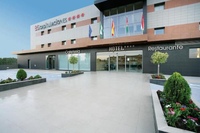
If you're passing through or looking for something special, try Restaurante La Pulga. This
modern, brightly lit restaurant was founded in 1965 and moved to its current location in the
Hotel Capitulaciones in 2004. It serves traditional dishes made with fresh, locally sourced
produce every day. The menu features homemade stews, fresh fish and shellfish, and grilled
meats such as lamb and oxtail. The homemade desserts are delicious.
Festivals
Popular festivals in Santa Fé are Las Capitulaciones de Santa Fé (Capitulations of Santa Fé), Fiestas de San Agustín (Feast of St Agustin, Patron Saint of Santa Fé), Festival Internacional de Teatro de Humor (International Festival of Comedy Theatre), Corpus Christi (Body of Christ), La Merendica (Remembering the signing of the Treaty of Granada), Candelaria (Candlemas) and Semana Santa (Holy Week/Easter). More>
Weather Forecast
The weather forecast for the next few days for Santa Fé. More>
Tourist Office
The tourist office of Santa Fé is located on Calle Isabel la Católica. More>
Nearby Places
The neighbouring villages to Santa Fé are Granada City and Moraleda de Zafayona.